

From record-breaking billion-dollar penalties for bribery violations in the US to significant AML enforcement actions across Europe, Lexology PRO explores the enforcement and rule change activity across ABC and AML to identify key risks and trends for businesses.
This series will cover the following work areas for the period November 2023 to November 2024: data protection, anti-bribery and corruption (ABC) and anti-money laundering (AML), banking, and sanctions.
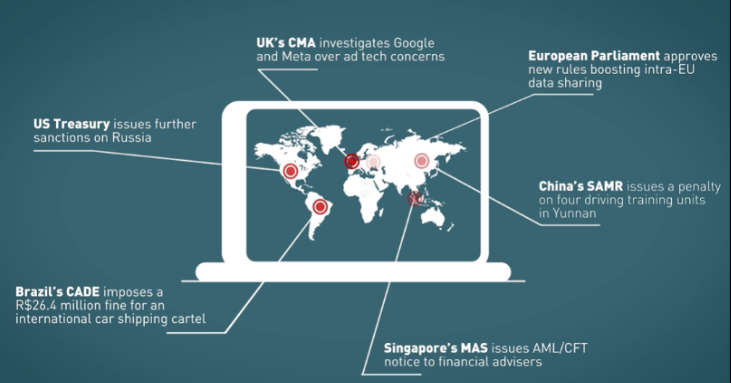
Scanner, our automated regulatory monitoring tool covers 14 regulatory areas and tracks over 1200 regulatory sources. We published over 33,000 regulatory updates between November 2023 and November 2024.
Please note that the data in this article is based on Scanner’s regulatory coverage, full details of which can be found here.
ABC enforcement activity
The United States continued to take significant enforcement actions, including a penalty of over US$950 million on defence contractor Raytheon Company (RTX) for defective pricing and foreign bribery. Swiss-based commodities trading company Gunvor also received a US$661 million penalty over Foreign Corrupt Practices Act (FCPA) violations in Ecuador. Domestic political corruption remained a focus for authorities, highlighted by the sentencing of Atlanta's former Chief Financial Officer for federal program theft and tax fraud, as well as the indictment of a former Louisiana Assistant District Attorney on charges of bribery, money laundering, and other offences.
Thailand ramped up ABC enforcement following changes to its anti-corruption framework in 2023. Public officials were targeted, including a series of cases involving misappropriations of school lunch subsidies. John Deere’s Thai subsidiary also made headlines after facing bribery charges from the US Securities and Exchange Commission (SEC).
In Brazil, the ongoing anti-corruption investigation “Operation Boca Livre” targeted the misuse of funds obtained through the Rouanet Law, leading to penalties for several companies. KPMG, already penalised for previous violations of this law, received an additional fine of R$989,693 (US$159,800) for attempting to bypass initial order to publish the conviction on its website.
South Africa maintained strong enforcement efforts, including convicting former Eskom officials for fraud and corruption and investigating the energy company’s contracts. German software giant SAP was ordered to pay R500 million (US$2.66 million) over its involvement in corrupt Eskom contracts. SAP also faced a US$220 million penalty from US enforcement agencies for related FCPA violations in South Africa and Indonesia.
AML enforcement activity
In the US, TD Bank faced record penalties exceeding US$3 billion for violations of the Bank Secrecy Act, marking the first instance of a bank pleading guilty to conspiracy to commit money laundering. The Office of the Comptroller of the Currency (OCC) took action against Wells Fargo in September 2024 for AML compliance deficiencies, mandating the bank to improve its procedures. The cryptocurrency sector has also been under close watch, with Binance fined US$4.3 billion over compliance failures, and coordinated actions taken against illicit Russian cryptocurrency exchanges.
Europe remained the region with the highest level of enforcement activity. Switzerland’s numbers were primarily driven by sanctions, but the Swiss Financial Market Supervisory Authority (FINMA) also took action against banks including Banque Audi and HSBC for AML compliance failures. In Norway, the Financial Supervisory Authority conducted numerous inspections of financial services institutions.
Despite having fewer enforcement actions overall, Sweden made headlines on 11 December 2024 for fining “buy now pay later” provider Klarna 500 million kronor (US $45.4 million) over AML compliance shortcomings.
In the UK, the Financial Conduct Authority (FCA) fined Starling Bank £29 million (US$36.5 million) on 2 October 2024 for failing to implement adequate customer controls and sanctions screening systems. Metrobank also received a fine from the UK FCA for a total of £16 million (US $20.2 million) on 12 November 2024 for failing to have appropriate AML measures in place.
The fallout from the Danske Bank money laundering scandal continued. French prosecutors fined Danske Bank €6.3 million (US $6.6 million), significantly lower than the US$2 billion fine the bank received from US authorities in 2022. The former chief executive of Swedbank, whose Baltic subsidiaries were involved in the scandal, was sentenced to 15 months in prison for misleading statements about the bank’s AML procedures.
AML rule change activity
The US was proactive in AML rule changes, with the Financial Crimes Enforcement Network (FinCEN) finalising a rule on beneficial ownership reporting and implementing measures against the Iraq-based Al-Huda Bank over terrorist financing concerns.
The EU published a comprehensive legislative package, including the 6th AML/CFT Directive. This package seeks to extend AML regulations to new sectors such as cryptocurrencies and luxury goods, harmonise rules across member states, and establish a centralised EU-level AML/CFT supervisory authority.
Amendments to China’s AML regime law, set to take effect on 1 January 2025, will impose stricter obligations on both financial and non-financial institutions. Key changes include extending the law to cover overseas activities, broadening the definition of money laundering, requiring more industries to comply with AML rules, and increasing penalties for non-compliance.