



Further to our recent article discussing the Building Canada Act and the announcement by the federal government to launch the Major Projects Office (MPO) to facilitate the advancement of major infrastructure and energy projects that are of national interest, the federal government has announced the first and second tranches of nation-building projects that have been referred to the MPO. Per the federal government’s recent statement, the projects referred to the MPO are linked to the following strategies:
- Realising Canada’s full potential as an energy superpower;
- Creating new trade and economic corridors to diversify our economy;
- Building our leadership in critical minerals to increase our independence; and
- Establishing our data sovereignty at a scale to serve Canadians safely and securely.
Moreover, if a project is designated as a “national interest” project, then the Building Canada Act would grant the federal government broad powers to streamline regulatory approvals and exempt a “national interest” project from specified federal legislation. This ability to deem a project of “national interest” has not been utilized for the 11 projects announced so far by the MPO; however, as will be discussed further below, the recently announced memorandum of understanding signed by Prime Minister Mark Carney and Alberta Premier Danielle Smith indicates that the federal government has committed to declaring a new Alberta bitumen pipeline project of “national interest” upon its eventual referral to the MPO for consideration.
The first tranche of projects announced on September 11, 2025 purportedly represent over $60 billion to the Canadian economy and would create thousands of jobs; these projects are as follows:
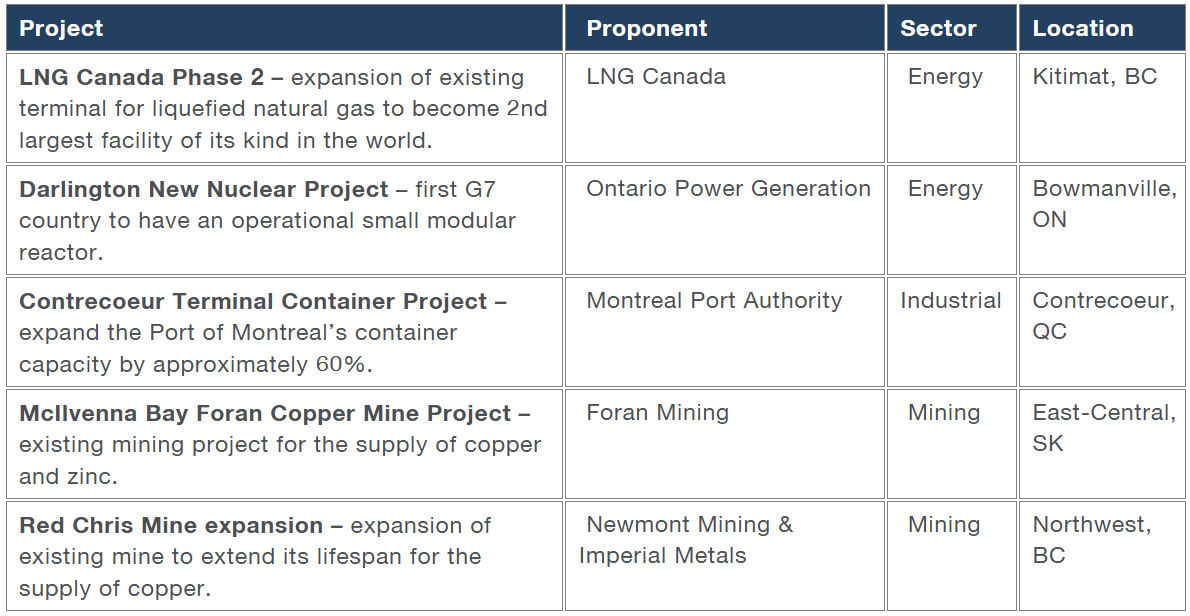
The second tranche of projects announced on November 13, 2025 purportedly represent over $56 billion to the Canadian economy and would support 68,000 jobs; these projects are as follows:
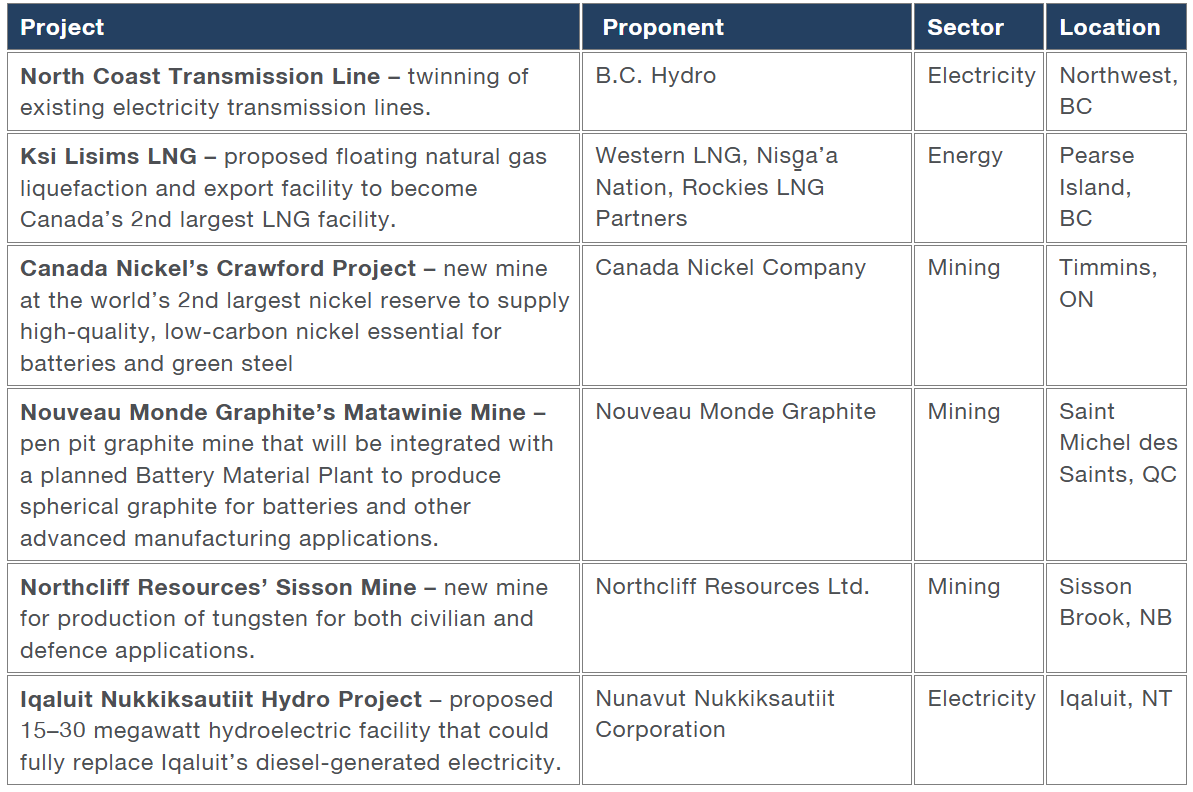
Although initially absent from the above 11 projects are any projects in Alberta, as a result of discussions and negotiations between Alberta and the federal government, on November 27, 2025, it was announced that Prime Minister Mark Carney and Alberta Premier Danielle Smith have signed a memorandum of understanding (MOU) regarding the construction of a bitumen pipeline from Alberta to the coast of British Columbia, whereby the application for this pipeline project is intended to be ready to submit to the MPO on or before July 1, 2026, and that this new pipeline would be in addition to the expansion of the Trans Mountain pipeline. Of significant note from the MOU is that the federal government commits to declaring the new pipeline as a project of “national interest”, which no project announced so far has been deemed; this means that the project may be exempt from specific federal legislation and a more streamlined regulatory process for approval. The MOU also stipulated various other construction projects, agreements, and commitments that Alberta and the federal government will jointly work towards – this MOU is discussed in more detail in the following recent BLG article.
Furthermore, in the announcement for the first tranche of projects, the federal government stated the following projects were also being reviewed which could indicate they may be included in the assumingly upcoming third tranche of projects:
- Critical Minerals Strategy: focus on mining projects involving critical minerals;
- Wind West Atlantic Energy: wind power project and associated support infrastructure in Atlantic Canada;
- Arctic Economic and Security Corridor: all-weather, dual-use, land and port-to-port-to-port infrastructure project;
- Port of Churchill Plus: upgrade the Port of Churchill and expand trade corridors with an all-weather road, an upgraded rail line, a new energy corridor, and marine ice-breaking capacity;
- Alto High-Speed Rail: Canada’s first high-speed railway, spanning approximately 1,000 km from Toronto to Québec City..