

The US and the EU have issued a joint statement providing further details on their trade agreement, marking “a first step” toward a binding pact.
Key takeaways
- The US and the EU announced a framework for a bilateral trade agreement that skews toward heavier EU obligations.
- Several of the framework’s measures appear aimed at China.
- Tariffs are a major component, but the framework also addresses a variety of other trade barriers.
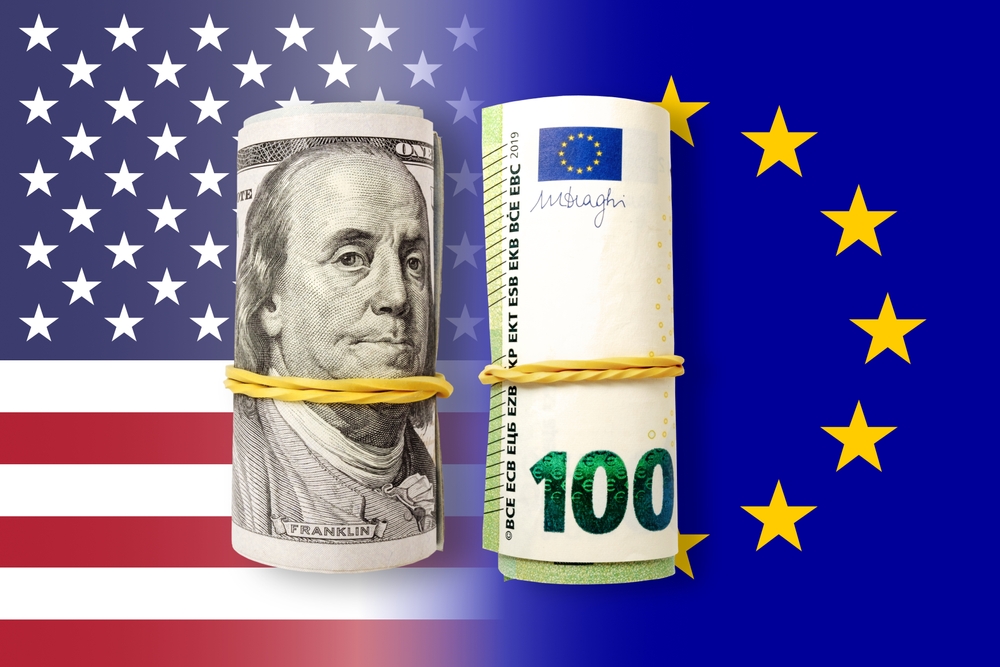
Shutterstock.com/Tomas Ragina
The parties issued the joint statement on the framework on 21 August 2025. The first step, however, was arguably the announcement of the deal in late July. Though it’s undeniably more than a “concept of a plan,” the US-EU trade agreement has yet to progress beyond the framework phase.
Here’s what we do know about the framework agreement.
15% ceiling
First, the maximum tariff rate generally applicable to EU goods entering the US would be 15%. That would apply to most goods, including pharmaceuticals, semiconductors, and lumber. The 15% ceiling could include the most favoured nation (MFN) tariff rate and a reciprocal tariff, and the US agreed to apply only the MFN rate to certain EU goods, including aircraft and aircraft parts, as well as generic pharmaceuticals and their ingredients. The US and the EU also acknowledged that “other sectors and products that are important for their economies and value chains” may qualify for the MFN-rate-only treatment.
The 15% maximum would not, however, apply to automobiles or auto parts, at least initially. Only once the EU formally introduces legislation to eliminate tariffs on all US industrial goods and provide preferential market access for US seafood and agricultural goods would the 15% ceiling apply to that critical European industry. The EU has indicated its intention to eliminate those duties, and both parties plan to accept and provide mutual recognition to their respective automobile standards.
Key terms listed
Second, the framework agreement will include at least 19 key terms (including the first three noted above), which are listed in the joint statement. The other terms highlight both mutual commitments and a variety of to-dos for the EU.
The mutual commitments include cooperation on export restrictions on critical minerals by, and the non-market policies of, third parties. Those promises may be intended to limit the economic influence of China, which is considered to have state-led, non-market policies as well as an abundance of rare earth minerals used in high-tech manufacturing.
The parties’ commitment to cooperate on energy also appears intended to address US adversaries’ economic influence. Related to that pledge of cooperation, the EU stated its intention to buy US$750 billion in US liquified natural gas, oil, and nuclear energy products through 2028. That may very well help the EU adapt to the changes in the European energy market resulting from Russia’s invasion of Ukraine. Similarly, the EU said it intends to buy at least US$40 billion worth of US AI chips – a commodity that figures prominently in US policy related to China.
Other mutual commitments in the framework include:
- reducing or eliminating non-tariff barriers on food and agricultural products, including streamlining requirements for sanitary certificates for pork and dairy products;
- negotiating a mutual recognition agreement on cybersecurity;
- discussing IP protection and enforcement;
- ensuring labour protections, including eliminating forced labour in supply chains (which also implicates China via the US’ Uyghur Forced Labor Prevention Act 2021); and
- addressing unjustified digital trade barriers.
The EU also signalled several unilateral commitments, such as:
- increasing military and defence spending;
- addressing US businesses’ concerns re EU Deforestation Regulation;
- being flexible on the Carbon Border Adjustment Mechanism (CBAM); and
- ensuring that the Corporate Sustainability Due Diligence Directive (CSDDD) and the Corporate Sustainability Reporting Directive (CSRD) don’t restrict transatlantic trade.
In addition, the EU and the US made clear in the framework their shared intention to promote and facilitate mutual investment. To that end, the framework provides that “European companies expected to invest an additional $600 billion across strategic sectors in the United States through 2028.”
Rules of origin
Perhaps most significantly, given the emergence of transshipment in the reciprocal tariff context, the two economic powerhouses announced in the framework agreement that they will negotiate rules of origin. Their stated goal with those rules will be to make sure that the benefits resulting agreement “accrue predominantly to the United States and the European Union.”
Time will tell if the development of rules of origin fares better than it did in the Transatlantic Trade and Investment Partnership (T-TIP), which fell apart during the first Trump administration.
Follow Lexology PRO’s US tariff tracker 2025 on the US’s latest trade policy.
Stay up to date with key developments and in-depth articles by following Lexology’s Trade & Customs research hub.
Track the latest trade and customs updates from authorities around the world using Scanner, Lexology PRO’s automated regulatory monitoring tool.