

US president Donald Trump’s new tariffs threaten to impact global commerce, but delays and contractual measures can help to mitigate associated risks.
Shutterstock.com/niroworld
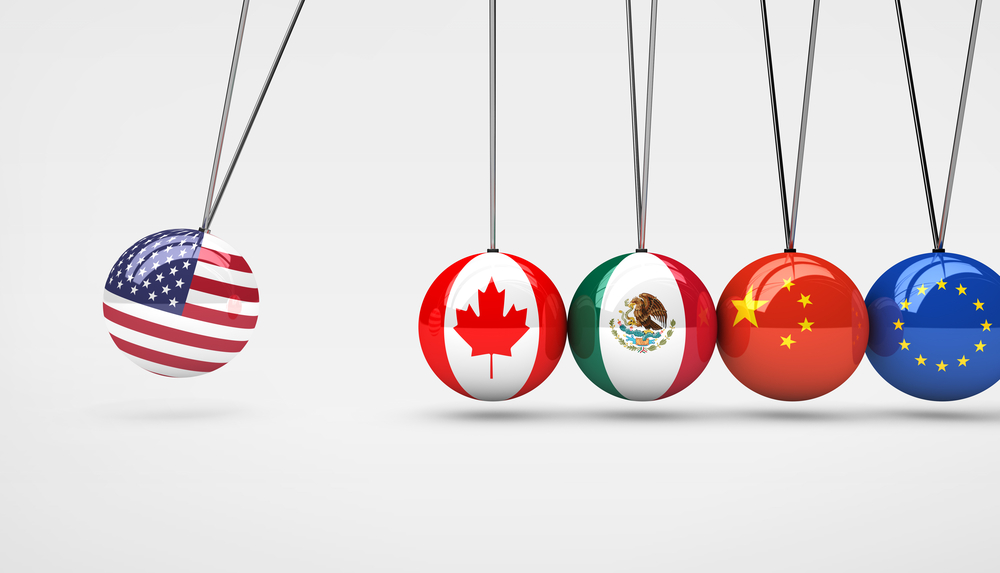
Trump followed through on his promise to impose tariffs on products of Canada, China, and Mexico on 1 February 2025, prompting varied reactions from those major US trading partners. Mexican President Claudia Sheinbaum and Canadian Prime Minister Justin Trudeau each persuaded Trump on 3 February 2025 to agree to a one-month delay until 4 March 2025, though Canada initially responded with tariffs of its own.
China announced targeted, retaliatory tariffs on 4 February 2025, the same day that the new customs duties began to apply to China origin goods.
The tariff rates vary, from 10% on China origin goods and Canada origin energy to 25% on Mexico and Canada origin goods.
The new customs duties share structural features. They’re in addition to any already applicable duties. And, the tariffs don’t allow for a de minimis exemption for shipments under US$800, drawbacks, or duty inversion benefits for goods entering the US through free trade zones.
The de minimis exemption is a big deal. According to the US Trade Representative (USTR), fiscal year 2024 saw 1.36 billion de minimis shipments. With approximately 4 million de minimis packages entering the US daily, most of which enter from China, US Customs and Border Protection (CBP) will have its hands full enforcing the new tariffs.
The US Postal Service (USPS) will too. USPS announced a temporary suspension on all parcels entering the US from China and Hong Kong on 4 February 2025, which was removed the next day. The removal notice directly acknowledged the need for USPS and CBP to “implement an efficient collection mechanism for the new China tariffs.”
The new US trade restrictions come amid considerable uncertainty as the first review of US-Mexico-Canada Agreement (USMCA) approaches, the US Senate considers the nomination of a new USTR, and existing contracts may not adequately address tariff-related commercial risks.
What’s the USMCA, anyway?
The postponement among the North American trading partners avoids – for now – perhaps awkward questions regarding the USMCA, which is one of 14 free trade agreements with 20 countries to which the US is a party. Trump’s reliance on emergency powers suggests that he may invoke an exception to the USMCA’s general prohibition on increasing or adopting new customs duties, which could align with a conventional US trade posture.
Each of Trump’s executive orders announcing the measures invoked emergency powers, including under the International Emergency Economic Powers Act 1977 (IEEPA), to combat the “sustained influx” of opioids – especially fentanyl. In Mexico’s case, Trump also cited the influx of illegal aliens as justification for the tariffs.
The signing and the entry into force of the USMCA occurred during Trump’s first term. The agreement entered into force on 1 July 2020, and its first statutorily mandated, six-year review is scheduled for 1 July 2026. The public consultation process for that review will begin by 1 October 2025.
The public consultation process for an USMCA interim final rule, in contrast, is currently underway. That rule, which was published on the last business day of the Biden administration, was not affected by the 20 January 2025 regulatory freeze and is scheduled to take effect on 18 March 2025. Its public comment period closes the same day. The interim final rule adds provisions implementing the USMCA as to textile and apparel goods as well as automotive goods, which could be affected by the Canada and Mexico tariffs, if implemented.
USTR focus on China
The US Senate confirmation hearing for Trump’s USTR pick, King & Spalding partner Jamieson Greer, is scheduled for 6 February 2025. Greer served as the chief of staff in the Office of the USTR during the first Trump administration. When he announced the nomination, Trump said that Greer “played a key role” in the signing of the USMCA and the targeted tariffs that Trump imposed on China.
More of the same may be expected from Greer as USTR, if confirmed. He testified in May 2024 before the US-China Economic and Security Review Commission that beginning in 2017, the US “embarked on a new approach toward China” on trade, moving away from annual renewal of most-favoured nation tariffs for China.
He noted several aspects of continuity from the first Trump administration to the Biden administration, including tariffs under section 301 of the Trade Act 1974 and section 232 of the Trade Expansion Act 1962. Greer credited those measures as important factors in “disentangling our supply chains from China” before providing his personal views on the matter.
“Speaking for myself, I view China’s stated ambitions and observed actions as a generational challenge for the United States.”
Though his testimony was less than a year ago, he did not specifically mention the China origin opioids Trump cited in the executive order imposing the new China tariffs.
Contract and other considerations
Tariffs are generally the buyer’s responsibility, but, as noted in Lexology PRO Checklist: International supply of goods contracts, contractual parties may negotiate other terms.
Use of the Incoterms® rule “Delivery Duty Paid” (DDP) is a standard way to shift responsibility for tariffs imposed on inbound goods. Under DDP, the seller bears the costs – including any customs duties – and risks associated with transporting the goods to an agreed upon place.
A DDP clause may, like this one from airport electronics retailer Capi’s general terms and conditions of purchase, incorporate Incoterm rules by reference:
Unless expressly agreed upon otherwise, delivery shall be made DDP (Delivered Duty Paid) at the place indicated by the Company. The interpretation of the terms and conditions of delivery shall be governed by the edition of the Incoterms issued by the International Chamber of Commerce which was most recent at the time the agreement was entered into.
The most recent edition of Incoterms was issued in 2020.
The Grain and Feed Trade Association’s contract for goods by rail and/or road represents another approach, in which the terms are defined in the contract itself:
DDP - Delivered Duty Paid - means that Sellers will deliver the goods on Sellers’ nominated transport cleared for import at the Place of Destination.
Under . . . DDP terms the goods will be at Sellers’ risk up to the Place of Destination.
Under DDP terms: Sellers shall customs clear the goods for export and import. All export and import duties, taxes, levies, etc. present or future, shall be for Sellers' account.
Whether seller or buyer has responsibility for paying a customs duty, payment should be made to the CBP via automated clearinghouse (ACH). CBP offers debit and credit options to withdraw funds through filers’ financial institution. The ACH debit option supports automatic payments, and the ACH credit option is limited to one-time withdrawal authorisations.