

Challenges to certain US tariffs have begun to work through the courts in quick succession. Where do things stand now?
No change as of now, but more judicial action is expected in the near term. The tariff challenges may work their way to the US Supreme Court before country-specific “reciprocal” tariffs are set to kick in on 9 July 2025.
Key takeaways
- An appeals court has stayed the US Court of International Trade's permanent injunction of two sets of tariffs that invoke emergency powers
- The affected duties are the "reciprocal" tariffs and the tariffs related to fentanyl trafficking, which have scheduled rate increases in July and August, respectively
- The appeal is expected to move quickly, but perhaps not quickly enough to avoid the rate increases
Shutterstock.com/JHVEPhoto
Many of the tariffs that US President Donald Trump has imposed in his second term have relied on the International Economic Emergency Powers Act 1977 (IEEPA), which grants the president emergency powers to “deal with an unusual and extraordinary threat with respect to which a national emergency has been declared.”
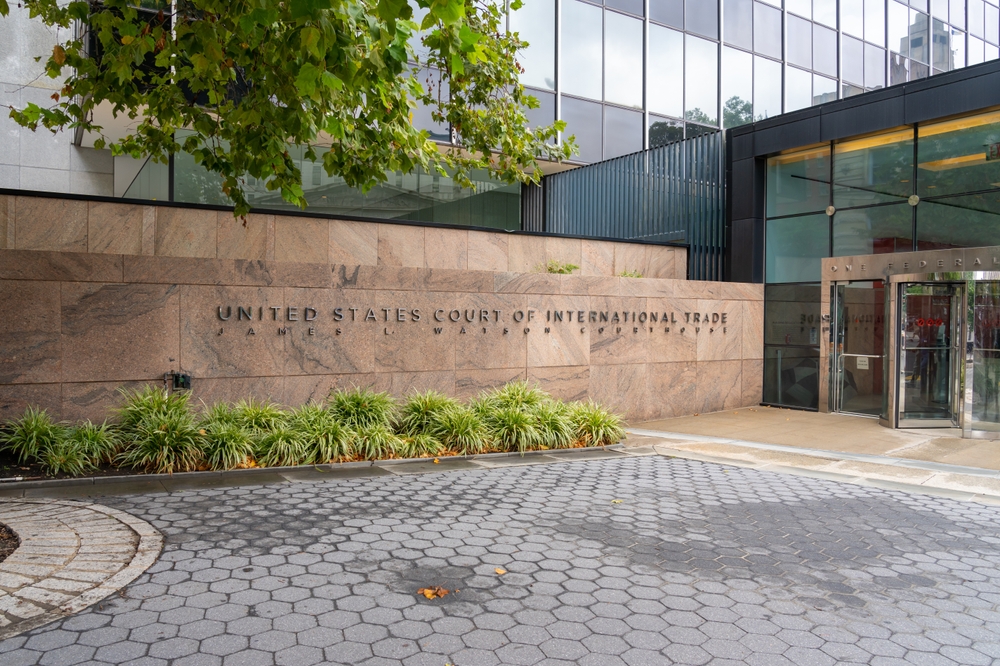
Trump has declared several national emergencies that he’s cited as the rationale for two sets of tariffs – trafficking tariffs ostensibly related to illicit opioids and reciprocal tariffs – which the US Court of International Trade set aside as unlawful on 28 May 2025. The trade court found that the IEEPA “does not authorize the President to impose unbounded tariffs” and that the tariffs imposed do not “deal with” their stated objectives.
Several businesses and an Oregon-led coalition of US states had filed similar suits independently, and the US Court of International Trade ruled on them jointly without consolidating them.
That decision was the first in a rapid succession of judicial moves that obscured the state of play on US tariffs in a two-day period. There is, however, no change in the application of the IEEPA-dependent tariffs. The swift intervention of a federal appeals court preserved the status quo – for now.
Wait – what happened?
The US government immediately appealed the trade court’s decision, which permanently enjoined the tariffs, to the US Court of Appeals for the Federal Circuit. Many businesses that had been affected by the tariffs, like the private plaintiffs in that case, breathed a collective sigh of relief.
That relief was short-lived. The following day, the Federal Circuit granted an immediate administrative stay of the 28 May injunction. The US government had also requested a stay in the US Court of International Trade, which was later held in abeyance. Trump said during a press conference on 30 May 2025 that he was pleased with the result, citing the executive’s need to be “fast and nimble” on trade issues. The Federal Circuit granted a stay pending appeal on 10 June 2025.
Meanwhile, also on 29 May 2025, the US District Court for the District of Columbia preliminarily enjoined the trafficking and reciprocal tariffs in a separate case brought by two toy companies. The US government also appealed this decision without delay, and the court granted a stay on 3 June 2025, citing the Federal Circuit's administrative stay.
Still another case, which California brought independently, is pending before the US District Court for the Northern District of California. The court heard a motion to transfer the case to the US Court of International Trade on 27 May 2025. During the hearing, California sought dismissal instead of a transfer. But, because California hadn’t addressed voluntary dismissal in its brief, the US government requested supplemental briefing on the matter on 30 May 2025. The district court denied the motion to transfer and dismissed the case without prejudice on 2 June 2025. California appealed to the US Court of Appeals for the Ninth Circuit the same day.
Which tariffs are impacted?
The tariffs at issue fall into two categories: trafficking tariffs and reciprocal tariffs.
The trafficking tariffs include the customs duties imposed on Canadian and Mexican products (25%), Canadian energy (10%), and Chinese products (20%).
The reciprocal tariffs include the duties announced on 2 April 2025, namely the 10% global baseline and the higher country-specific rates that were later suspended.
Other tariffs, like those applicable to steel, aluminium, and automobiles and auto parts are unaffected by the judicial challenges, as those measures do not invoke the IEEPA.
What’s next?
The Federal Circuit directed the parties to propose an expedited briefing schedule, with oral argument tentatively slated for 31 July 2025. Notably, that would occur after the country-specific reciprocal tariffs are scheduled to take effect on 9 July 2025.
Without the Federal Circuit’s intervention, the trade court’s decision would have required the rescission of the tariffs by 7 June 2025.
The other appeal in the Ninth Circuit is moving more slowly, with the opening brief due by 25 August 2025.
What can importers do?
Protest. Or, rather, prepare to protest. Trade counsel are advising their clients to watch the appeals process closely and to file a protest challenging the payment of later-invalidated customs duties within 180 days of liquidation.
US Customs and Border Patrol Form 19 is used to file such protests.
The liquidation date is generally the date the importer pays the duties due on entry. For the reciprocal tariffs, the protest window is wide open. Assuming, for example, that an importer paid a 10% reciprocal tariff on the first day of that duty’s applicability (5 April 2025), the importer would have until 2 October 2025 to file a protest.