

US President Donald Trump has moved to “eliminate the use of disparate-impact liability” in employment practices through a new executive order.
Shutterstock.com/Babooo0
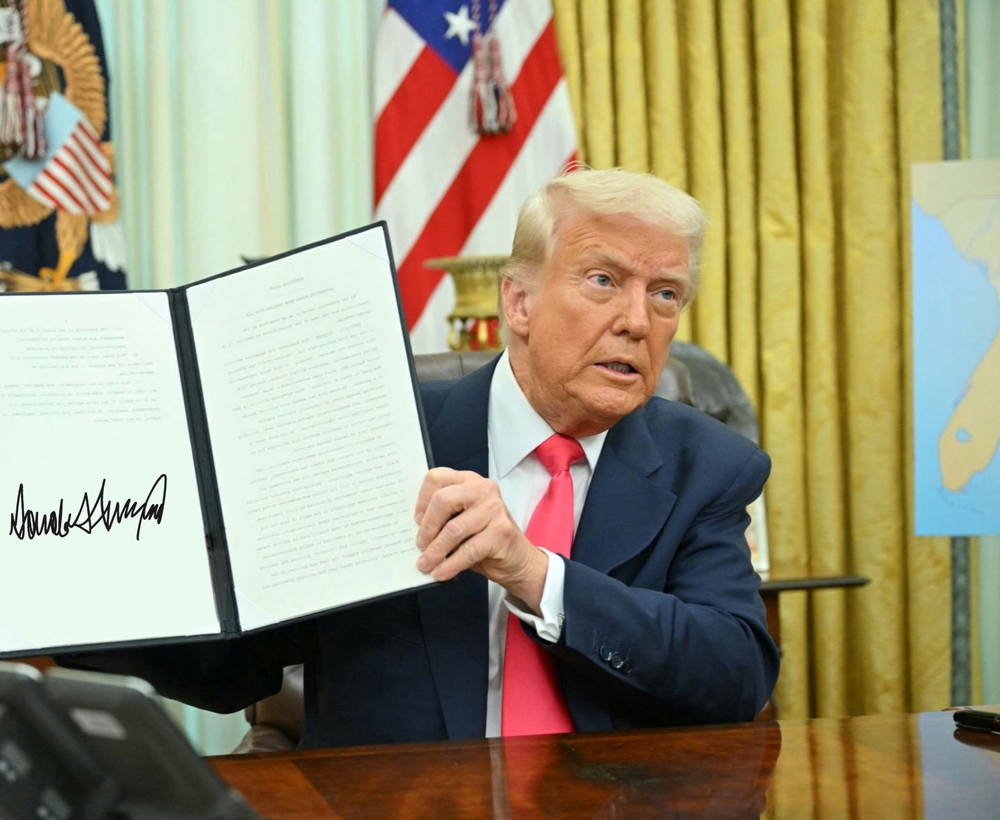
Trump issued his Restoring Equality of Opportunity and Meritocracy executive order (EO) on 23 April 2025. Trump asserted that disparate-impact liability “is wholly inconsistent with the Constitution and threatens the commitment to merit and equality of opportunity that forms the foundation of the American Dream.”
The US Department of Justice (DOJ) characterises investigations into disparate-impact liability cases as “focus[ing] on the consequences of the recipient’s practices, rather than the recipient’s intent.” Disparate impact has long been considered a violation of Title VII of the Civil Rights Act 1964, though Trump’s 23 April EO identifies it as part of a “pernicious movement” that seeks “to transform America’s promise of equal opportunity into a divisive pursuit of results preordained by irrelevant immutable characteristics, regardless of individual strengths, effort, or achievement.”
“Disparate-impact liability all but requires individuals and businesses to consider race and engage in racial balancing to avoid potentially crippling legal liability,” the EO states. “It not only undermines our national values, but also runs contrary to equal protection under the law and, therefore, violates our Constitution.”
Johnathan Smith, chief of staff and general counsel at the National Center for Youth Law, said disparate impact is “simply a way to test whether, outside of intent, there are the kind of practices that have the effect of discrimination.”
“I think that the EO was framed in the context of equal opportunity, and I suspect that what [the government] would say is that . . . there are a lot of statistical disparities along the lines of race and gender and that just becomes a blank check to make any type of racial profile,” Smith said. “But that’s not how disparate impact works. It doesn’t just say, ‘there’s a disparity, therefore it’s illegal.’ It says if there’s a disparity, you need to ask more questions to understand why it exists.”
Trump claims in the EO that disparate-impact liability “has made it difficult, and in some cases impossible, for employers to use bona fide job-oriented evaluations when recruiting, which prevents job seekers from being paired with jobs to which their skills are most suited.” He said disparate-impact liability has prevented employers from acting “in the best interests” of themselves, their employees, and their customers.
The order revokes several Title VII regulations and mandates that all federal agencies “deprioritize enforcement of all statutes and regulations to the extent they include disparate-impact liability.” Trump has also directed the US attorney general and acting chair of the US Equal Employment Opportunity Commission (EEOC) Andrea Lucas to “assess all pending investigations, civil suits, or positions taken in ongoing matters” under all civil rights laws that “rely” on disparate-impact liability, including Title VII.
Further, Lucas and the attorney general will be issuing joint guidance “to employers regarding appropriate methods to promote equal access to employment regardless of whether an applicant has a college education, where appropriate.”
Jeffrey Sultanik, partner at Fox Rothschild, said Trump’s EO is “designed to reflect the intent of the administration,” but that the directive does not “immediately change anything.”
“There will be required legislation and actions to implement the terms of the EO. Various agencies would need to take action, certain laws would have to be changed, in my opinion, in order to effectively impact any change,” Sultanik said. “But the implementation has yet to come down the road, and the devil is always in the details.”
Similarly, Smith said any efforts to eliminate disparate impact from existing statutes “will take some time.” He also noted that the directive calls for “a broader review of how federal agencies have been using disparate impact,” and that it will become clearer within the next few months whether the agencies “seek to change consent decrees or settlement agreements that have a lot of disparate impact, for example.”
Smith did acknowledge that the 23 April EO may particularly impact federal grant recipients under Title VI, as the government will have more jurisdiction over which claims are brought.
“I think in the Title VI space, we might see more immediate impact because the president’s prosecutorial discretion will allow him to bring none of those claims if he doesn’t want to,” Smith said. “For Title VII, rather, you’ll find that plaintiffs can continue to rely on disparate impact, and nothing about the EO kind of changes that.”
Trump’s EO marks the administration’s latest effort to eliminate diversity, equity and inclusion (DEI) practices. The president began his second term by issuing two executive orders addressing “illegal” DEI, as well as diversity, equity, inclusion, and accessibility (DEIA). The government has since taken steps to root out federal and private sector DEI, specifically targeting law firms and federal contractors through various directives.
Sultanik said yesterday’s EO differed from the government’s previous efforts because it “was less tied to federal financing” and more of a “statement of direction of the administration in addressing a number of different areas.” He said prior EOs about DEI explicitly “threatened the withdrawal” of funding, while there were “many, for lack of a better word, disparate issues raised” in the most recent order.
Smith said the EO is “consistent” with Trump’s actions thus far. He said all of Trump’s DEI-related orders have “made it harder to litigate civil rights cases, and for plaintiffs to prevail in civil rights cases.”
Nonetheless, Smith encourages employers to continue considering disparate impact by “narrowly tailoring” their policies.
“The government is not going to be using disparate impact, taking it out of statutes and making it harder for people to bring disparate impact claims. But I don’t think there’s anything that stops an employer from wanting to do the right thing,” Smith said. “They should still make sure that their policies are fair and just.”