

The key sanctions imposed since the start of 2025 in relation to the Israel-Hamas conflict, including the EU extending restrictive measures, while a UK court hears that country’s sale of arms to Israel is unlawful.
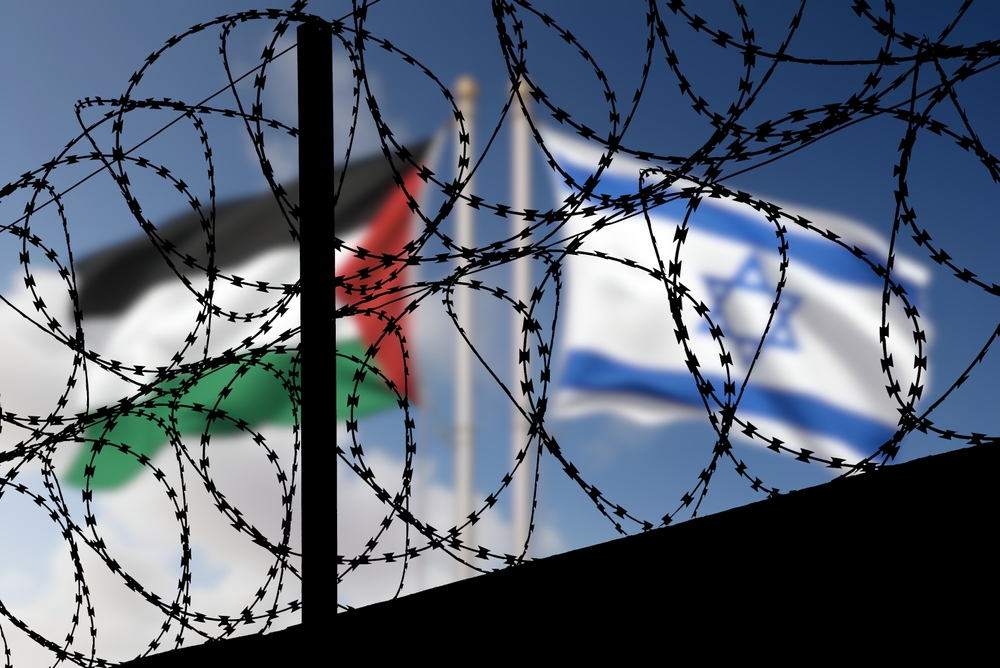
Shutterstock.com/Bartolomiej Pietrzyk
On 7 October 2023, members of a militant group, Hamas, launched a surprise attack in Israel. More than 18 months later, military activity continues across the region, leading to many casualties and impacting world trade and diplomatic relations.
Repeated efforts by the international community to broker peace between Israel and Hamas have gone unrewarded. A ceasefire agreed back in January lasted no longer than two months, as Israel resumed airstrikes on 19 March 2025.
Hopes that US President Donald Trump’s return to the White House would help bring about an end to the conflict have also petered out. He started his second term by clearly signalling his allegiance to Israel, before appearing to change tack by circumventing the Israeli government during negotiations with Hamas and Yemen’s Houthis in May.
Nations around the world continue to sanction Hamas-affiliated individuals and financial supporters, while certain countries are restricting trade with Israel.
To help companies stay up-to-date and ensure they are compliant with the different sanctions whilst managing the impact on their operations, this article outlines the crucial sanctions imposed since 1 January 2025. Click here to see the full timeline of events from the start of the conflict until 31 December 2024.
The situation in Gaza is changing constantly, so we recommend consulting government websites and media outlets for the most up-to-date information.
Analysis
Trump lifts West Bank settler sanctions, plans to transform Gaza
Upon his return to the White House, Trump indicated he would robustly support Israel in the conflict with Hamas. During his first week in office, the president rescinded an executive order signed by his predecessor Joe Biden on 1 February 2024 allowing sanctions against persons deemed by the US to be involved in activities threatening the peace, security and stability of the West Bank. Consequently, the Treasury’s Office of Foreign Assets Control (OFAC) lifted sanctions on 30 Israeli settler groups and entities.
In the same flurry of executive orders, Trump created a legal basis to issue sanctions against the International Criminal Court (ICC), including officials, employees, agents and their family members. The administration sanctioned members of the ICC, alleging that the court “abused its power by issuing baseless arrest warrants” targeting Israeli prime minister Benjamin Netanyahu and former defence minister Yoav Gallant.
The US-Israel relationship was put on show on 7 April 2025, when Netanyahu visited Trump at the White House. Israeli PM said during the press conference that the two countries were working towards Trump’s “vision” for Gaza.
During this meeting, Trump explained his plans for the US to take control of Gaza to ensure stability, relocate Gazans to Egypt and Jordan and redevelop the strip into the “Riviera of the Middle East.” Reactions to these comments were overwhelmingly negative, including from Saudi Arabia and Egypt, as well as US Democrats.
Trump chose the Middle East as the first overseas state visit of his second term, a repeat of his first international trip in 2017. The visit started in Saudi Arabia on 13 May 2025, and continued onto Qatar and the United Arab Emirates, but missed out Israel. Rather than focusing on peace talks or ceasefire negotiations, the state visit targeted ‘mega deals’ such as a US$142 billion arms deal with Saudi Arabia.
The trip came just days after the US negotiated its own ceasefire with the Houthis over commercial shipping routes in the Red Sea. That deal “blindsided” Israel and left the Israeli government “puzzled.”
The US also reportedly negotiated the release of US-Israeli hostage Edan Alexander directly with Hamas via a US administration official in Qatar. Hamas released Alexander on 12 May 2025.
These two instances of the US sidelining Israel during negotiations could indicate a shift in the US approach to the conflict and its resolution. Reports also suggest that the relationship between Trump and Netanyahu has become strained.
Ceasefire remains a priority
Several countries – particularly in the Middle East – are involved in the peace process. On 19 January 2025, following months of negotiations led by the US, Qatar and Egypt, a ceasefire agreement took effect, including the release of hostages held by Hamas in exchange for Palestinian prisoners held by Israel.
The US looked to extend the ceasefire in March 2025. White House envoy Steve Witkoff participated in indirect talks in Qatar to prolong the truce, but the agreement broke down just days after these talks.
United Nations Secretary-General António Guterres renewed his call for a permanent ceasefire on 12 May 2025, urging “an end to the hostilities, the provision of humanitarian aid and the long-overdue alleviation of the human suffering in Gaza.”
Guterres also praised the sustained mediation efforts of Egypt, Qatar and the US to bring an end to the fighting.