

Governments are tightening employment regulations with stricter disclosure rules, new reporting obligations, and more rigorous enforcement mechanisms.
New employment laws are reshaping workplace obligations globally, as governments modernise labour frameworks and strengthen protections for workers. With multiple critical changes taking effect on 1 September 2025, companies must stay informed and act swiftly to meet the evolving compliance landscape and avoid significant penalties.
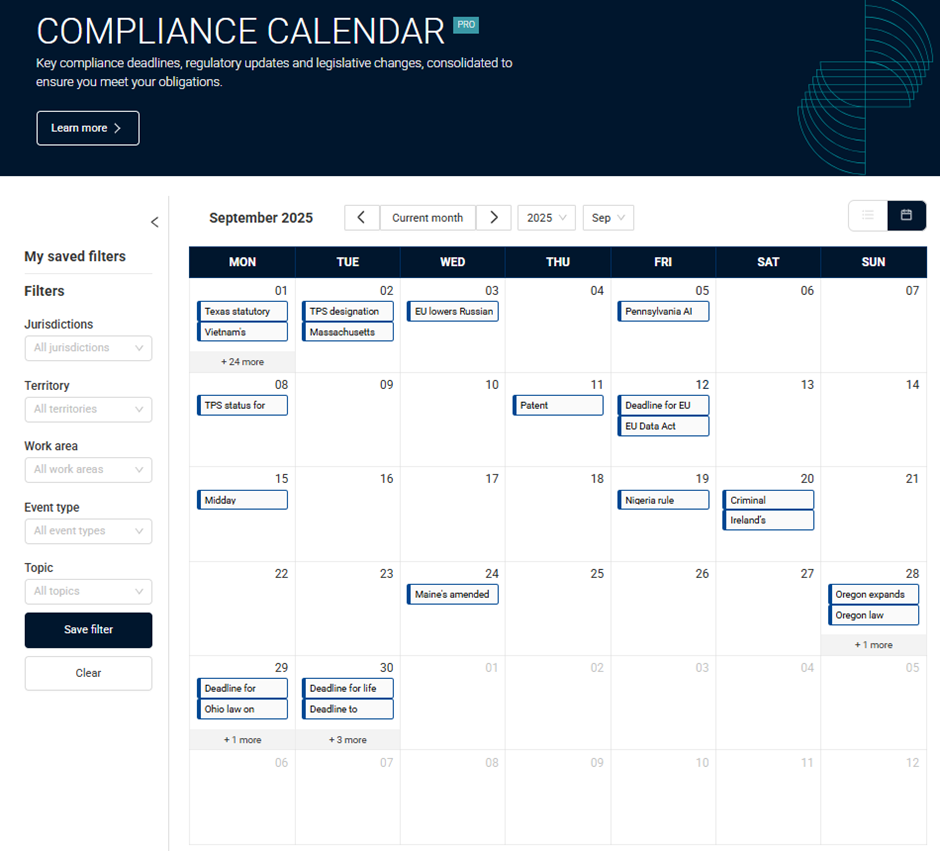
Track critical dates with our interactive Compliance Calendar, your essential guide to enforcement deadlines across all compliance areas.
Egypt’s labour reforms come into force with tougher penalties for non-compliance
Egypt’s new Labour Law No. 14 (Arabic language only) enters into force on 1 September 2025, aimed at modernising the legal framework and improving worker protections. Businesses failing to comply with the new measures face much tougher financial penalties than under the former law.
The new law requires all employers to submit a detailed report to the Ministry of Manpower on the number of workers they employ, including foreign nationals, their qualifications, job titles, wages, and demographic information by 30 September 2025, or from the date of commencing operations.
Employment contracts now demand four Arabic copies to be issued to the employer, worker, Social Insurance Authority, and the relevant administrative body. Employers must also ensure proper classification of contracts; verbal or indefinite agreements will be presumed permanent unless otherwise justified.
Private sector employers must provide employees with an annual raise of at least 3% of their social insurance salary.
The legislation formally recognises modern working arrangements, including remote work, part-time roles, flexible hours, and job sharing. Crucially, remote workers will get the same protections as those on-site.
Women receive enhanced protections alongside expanded leave entitlements. Maternity leave extends from 90 to 120 days, while paternity leave becomes available for the first time. Mothers can access unpaid childcare leave for up to two years, and annual leave increases from 15 to 20 days during employees' first year of service. In addition, employers will bear responsibility for maintaining safe and respectful work environments, as harassment, bullying, and workplace violence become explicitly criminalised under the new law.
South African employers must implement employment equity plans
Under Employment Equity Regulations published in April 2025, employers with more than 50 employees must submit a five-year employment equity (EE) plan by 31 August 2025, to be implemented from 1 September 2025 to 31 August 2030.
Designated employers must revise their EE plans to apply sector-specific transformation targets, as set out in section 15A of the Employment Equity Act 1998. These are aimed at achieving equitable representation for designated groups – including African, coloured and Indian people, women, and people with disabilities – at all occupational levels. Recruitment, promotions and workforce planning should be aligned accordingly.
Employers must use the new forms (EEA12 and EEA13) published by the Ministry of Employment and Labour to prepare their revised employment equity plans and report on their progress annually.
Designated employers must meet sectoral targets or have reasonable grounds for non-compliance or risk being issued a compliance order. This will either give a business the chance to rectify non-compliance or impose a fine ranging from ZAR 1.5 million (US$84,870) to ZAR 2.7 million (US$152793), or 2-10% of annual turnover.
Employers will only be able to obtain a certificate of compliance to carry out government work if they have met the applicable sectoral targets, have reasonable grounds for non-compliance and have not been found in breach of unfair discrimination.
New salary thresholds to qualify for Singapore’s S Pass work visa
From 1 September 2025, Singapore is raising the salary requirement for new applications for S Pass work visas, originally designed for mid-level skilled workers, so that only higher-skilled workers are employed under this category.
To be eligible, employers must offer a salary that meets or exceeds the new minimum, which will increase from S$3,150 (US$2,453) to S$3,300 (US$2570) for all sectors except financial services. The threshold will be raised from S$3,650 (US$2843) to S$3,800 (US$2959) in financial services. The salary thresholds will continue to increase progressively with age for those over 45 years.
The monthly levy employers pay to the government for hiring S Pass holders for Tier 1 workers will also increase from S$550 (US$428) and be standardised with the Tier 2 levy at S$650 (US$506).
Texas ban on nondisclosure clauses for sexual abuse claims takes effect
Effective 1 September 2025, Texas employers must comply with Senate Bill 835, a new law that voids and prohibits confidentiality and nondisclosure clauses that restrict disclosures regarding sexual abuse. The new law applies retroactively to any agreement made before or after the effective date, including employment contracts and settlement agreements, unless a court order permits non-disclosure.
An “act of sexual abuse” includes indecency with a child, sexual assault, aggravated sexual assault, sexual performance by a child, sex trafficking and compelling prostitution.
However, the law still allows parties to keep certain aspects of a settlement agreement confidential, such as the amount or payment terms, as long as the confidentiality requirement does not prevent disclosure of sexual abuse or related facts.
Stricter enforcement powers targeting non-compliant PEOs come into force in Texas
New rules coming into force on 1 September 2025 under Senate Bill 1254 will amend Chapter 91 of the Texas Labor Code 1993, clarifying how Professional Employer Organisations (PEOs) are licensed and regulated. The definition of "license holder" will specifically refer to a person who holds a license issued by the Texas Department of Licensing and Regulation (TDLR).
The legislation also introduces an 18-month grace period following license expiration, during which a PEO may retain its status as an employer. After this window, if a license is not renewed, the PEO’s employer status is terminated.
Importantly, TDLR’s disciplinary powers have been expanded. Employers offering or engaging in PEO services may now face enforcement action regardless of whether they are currently licensed under the strengthened regulatory framework.