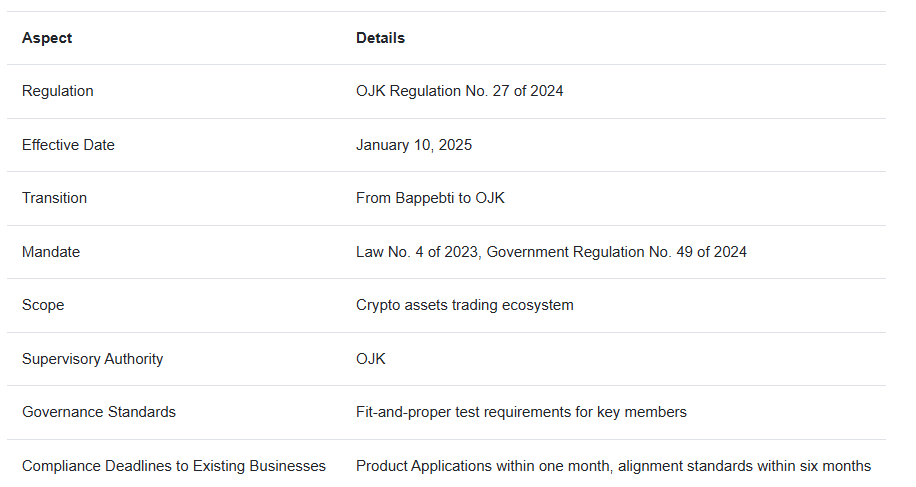

The Indonesian cryptocurrency landscape is on the brink of transformation. Through the Indonesian Financial Services Authority (Otoritas Jasa Keuangan,“OJK”) Regulation No. 27 of 2024[1] (“OJK Reg. 27/2024”) effective from January 10, 2025, the regulatory framework for crypto trading has shifted from the Commodity Futures Trading Supervisory Agency (“Bappebti”)[2] to the OJK. This change marks a significant milestone in the evolution of digital financial asset regulation under Indonesia's financial sector reform agenda, in accordance with Law No. 4 of 2023, dubbed the omnibus law in the financial sector (“Law 4/2023”).
Further mandate from a newly enacted Government Regulation
Effective on January 10, 2025, Government Regulation No. 49 of 2024[3] (“GR 49/2024”), the long, awaited implementing regulation of Law 4/2023, officially transfers regulatory and supervisory authority for digital financial assets, including crypto assets and financial derivatives from Bappebti to OJK, and, in some cases, Bank Indonesia.
Under GR 49/2024, Bank Indonesia will assume authority over financial derivatives related to money markets and foreign exchange markets, while OJK will oversee crypto assets and securities derivatives.
In this article, we focus exclusively on crypto assets. Separate articles will address the regulatory transition for financial derivatives as mentioned above.
Broader Scope and Authority
Under the Bappebti regime, regulation focused on “crypto assets” and their physical trading through futures exchanges. OJK Reg. 27/2024 adopts a broader perspective, introducing the term "digital financial assets." This shift encompasses not only crypto assets but also other digital financial instruments, hinting at greater regulatory flexibility to accommodate emerging innovations in the future.
Streamlined Business Actor Categories
Previously, Bappebti's two-tiered system of prospective physical traders of crypto assets (Calon Pedagang Fisik Aset Kripto, “CPFAK”) and (ii) physical trader of crypto assets (Pedagang Fisik Aset Kripto) was designed to address the absence of a dedicated crypto exchange and clearing house during the nascent stages of Indonesia’s crypto market. OJK Reg. 27/2024 now streamlines this framework by eliminating the CPFAK designation.
Moreover, OJK Reg. 27/2024 aligns digital financial asset (crypto asset) traders with the “organiser of technological innovation in the financial sector” (“FSTI”) framework, as set forth in OJK Regulation No. 3 of 2024.[4] ABNR Note: we have covered this FSTI topic here.
Governance Upgrades
Corporate governance standards will be strengthened under OJK’s oversight. New business actors will need to meet OJK’s own fit-and-proper test requirements applicable for key members, including, potential directors, commissioners, and the controlling shareholder, aligning with the existing rules on fit-and-proper test within the financial sector.
Transition and Compliance Deadlines
To ensure continuity, existing licenses and product or instrument approvals issued by Bappebti will remain valid. However, unlicensed existing crypto products or ongoing activities are still permitted for trading, provided that these licensed entities apply for approval from OJK within one month of the regulation’s effective date.
Furthermore, licensed businesses must adhere to OJK’s governance and operational standards, among others, consumer protection and data protection requirements by July 2025.
The Crypto Whitelist: What’s New?
Interestingly, just prior to this official transition, Bappebti’s final act before handing over the regulatory baton to the OJK was to significantly expand the list of tradable crypto assets to 1,396 (Bappebti Regulation No. 1 of 2025).[5] Here, OJK Reg. 27/2024 requires that licensed crypto exchanges (i.e., CFX[6]) conduct a comprehensive review of all previously approved assets and publish an updated list within three months of the regulation’s effective date, placing the deadline around April 2025. ABNR Note: on the whitelist, we have covered a similar topic here.
ABNR Remarks and Conclusion
The handover of crypto oversight from Bappebti to OJK marks a pivotal moment for Indonesia's financial sector. Envisioned under Law 4/2023, this transfer has been a topic of intense discussion for two years, underscoring its importance in shaping the future of digital financial assets in Indonesia.
OJK’s approach in this takeover emphasises a “soft landing,” building upon the foundational framework established under Bappebti while aligning with the authority’s broader objectives: such as, financial sector consumer protection, the introduction of OJK’s governance standards and fit-and-proper test requirements, market stability, and technological innovation.
By incorporating crypto-related activities under the extensive financial sector technology innovation (or FSTI, as discussed above) umbrella, OJK demonstrates its commitment to integrating crypto into the mainstream financial system.
This transition poses challenges, such as adjusting to new compliance requirements, including the need for licensed entities to meet enhanced operational and governance standards within six months of the regulation’s effective date. At the same time, OJK’s directive for the licensed exchange (CFX) to review and publish an updated crypto whitelist by April 2025 introduces an additional layer of scrutiny that could reshape the market.
Despite these hurdles, the benefits of this transition are clear. By establishing a cohesive regulatory framework, OJK has laid the groundwork for a more secure and reputable market, attracting both domestic and international stakeholders. For businesses and investors, this shift represents an opportunity to align with global best practices while gaining access to a more mature and integrated market environment.
This transition represents an exciting yet crucial phase for the Indonesian crypto market. Now is the time for industry players to adapt and thrive. For new businesses and investors seeking clarity, early preparation and a thorough understanding of OJK Reg. 27/2024 are indeed key.
For inquiries or further guidance, our team is ready to assist. Additionally, for our Indonesian speaking audience, we invite you to explore this topic further in Episode 10 of the ABNR Foundation Podcast Series, available here.
TL;DR: