


It is a well-accepted principle that the courts, while dealing with cases of trademark infringement, must compare the marks ‘as a whole’. The marks should not be dissected into components for comparing only parts of the rival trademarks to determine the likelihood of confusion amongst consumers. The said rule is widely known as the Rule of anti-dissection and finds its origins in Section 17 of the Trade Marks Act, 1999 that provides, “when a trade mark consists of several matters, its registration shall confer on the proprietor exclusive right to the use of the trade mark taken as a whole. Section 17 also specifies that where a mark consists of several elements, it disentitles a registered proprietor to claim exclusive rights over the different elements of the composite mark unless the same has been registered separately by the proprietor.
A composite mark may be made up of a combination of two or more words or a combination of a logo and a word mark. While the registered proprietor can enforce his rights when the mark ‘as a whole’ has been copied by a third party, the real controversy arises when the Defendant copies only a part/element of the composite mark. It is in these circumstances the Courts are called upon to determine whether the copied element is the dominant feature of the mark to hold that the Defendant’s use constitutes infringement. To elaborate, in cases where the Defendant copies not the entire mark but a particular element of a composite mark which enjoys greater prominence in a composite mark or is the dominant part of the composite mark, the Courts have held such use to be infringement. The rule of ‘dominant feature’ finds its premise in the settled principle that an average consumer with imperfect recollection is bound to remember and identify a brand/ trademark by the dominant/ prominent part of the mark and therefore, the dominant feature of the mark deserves more attention. The rule of Anti-Dissection and the rule of dominant feature are not antithetical to each other but rather complement one another. There exists a vast jurisprudence on the infringement of a composite mark where the infringer has copied only some elements of the mark and not the composite mark “as a whole”.
The cases outlined below reiterated the principle of dominant feature and comparing the composite marks and holding marks to be similar marks
1. Amar Singh Chawal Wala v. Shree Vardhman Rice and Genl. Mills 159(2009)DLT267 The court while comparing the marks GOLDEN QILLA/ LAL QILLA/LAL QILLA CHAPP/ NEELA QILLA/ and HARA QILLA, protected the rights of a registered proprietor of the composite mark in the essential element of the mark and held:
“In the instant case as far as the registered marks in favour of the plaintiff are concerned, applying the test laid down in Kaviraj Pandit it is seen that the essential feature of the mark is the word ‘QILLA’. Whether the word is spelt as QILLA or KILLA, or even written in a different style or colour combination. To the customer who seeks to purchase the QILLA brand rice both names would sound phonetically similar. The customer is likely to ask the retailer: “Can I have the QILLA brand rice?” In the considered view of this Court, it is this essential feature of the plaintiff's mark, i.e. the word QILLA, which has been adopted by the Defendant No. 1. That the defendants have also used a pictorial representation of the device in the form of a fort also indicates that the Defendants too intended the same meaning to be assigned to the word, which is an Urdu one meaning “fort”. Therefore, though the device QILLA is depicted in a slightly different way by the defendant, it is deceptively similar to the device used by the plaintiff. Further the use is in respect of the same commodity, rice. Therefore there is every possibility of there being a confusion created in the mind of the purchaser of rice that the product being sold by the Defendant is in fact a product that has emanated from or has been manufactured by the plaintiff.”
2. The need for protection to be granted to essential/ dominant features of a composite mark was further reiterated by the Division Bench of Delhi High Court in Kirorimal Kashiram Marketing and Agencies Pvt. Ltd. v. Shree Sita Chawal Udyog Mill 2010/DHC/4248-DB. While dealing with the rival marks ‘Double Deer’ and ‘Golden Deer’ with respect to rice, the Hon’ble Court overturned the order passed by the Single Judge and observed that “Deer” forms an essential part of the Appellant’s mark Double Deer and the same having no connection with rice, is therefore arbitrary adopted. The Court held:
“Copying of a prominent part of a trademark leads to deceptive similarity especially when the product of both the parties is the same. The expression "Deer" was arbitrarily adopted by the appellant with respect to its product being rice. A deer has no connection or co-relation with the product namely rice. Such arbitrary adoption of a word mark with respect to a product with which it has no co-relation is entitled to a very high degree of protection, more so, as the appellant's trademark is a registered trademark. The use by the respondent of its trademark is admittedly subsequent to that of the appellant.”
The Court further relied on a foreign judgement to uphold that the benefit of “…no one can copy an essential part or predominant part of a trade mark and the benefit of prior use doctrine will also be available to an essential/prominent/predominant part of trade mark i.e. an important part of a trade mark of another person…”. The Court ultimately allowed the appeal and observed:
“we are of the firm opinion that only one view is possible in the facts of the present case because not only the appellant/plaintiff was the prior and the registered user of the trademark, the adoption of the respondent/defendant was not honest and it is not permissible to copy a prominent part of the registered trademark of another person, more so, when the said word mark is arbitrarily adopted with respect to the product in question. The balance of convenience is clearly not in favour of the defendant/respondent but is in favour of the appellant/plaintiff who will be caused serious, grave and irreparable injury with respect to its ownership and goodwill in the trademark “Double Deer”.”
3. One of the most notable judgments dealing with infringement of elements of a composite mark is South India Beverages Pvt. Ltd. v General Mills Marketing Inc., (2015) 61 PTC 231 wherein the Delhi High Court analyzed the Rule of Anti-Dissection and Dominant Feature of a composite mark. The marks in question were HAAGEN DAZS and D’DAAZS. The Court, in the present case, rejected the Defendant’s contention that the Rule of Anti-Dissection allows a party to copy an element of the trademark and the same would not result in complete appropriation of the registered trademark and held:
“…while a trademark is supposed to be looked at in entirety, yet the consideration of a trademark as a whole does not condone infringement where less than the entire trademark is appropriated. It is therefore not improper to identify elements or features of the marks that are more or less important for the purpose of analysis in cases of composite marks.”
4. The Court in Apaar Homez Mart Pvt. Ltd. v. Century World, 2022/DHC/3495-DB, correlated/ harmonized the Rules of anti-dissection and dominant feature while dealing with the rival marks CP CENTURY, CWPL CENTURY, and SEPAL CENTURY and upheld the established principle of comparing the rival marks as a whole and observed:
“The question whether the trademark adopted by the appellant infringes the respondent's registered trademark is required to be determined by examining the trademarks adopted by the parties as a whole. There is merit in the contention that the grant of a registration in respect of a device mark cannot be construed as registration of a part or a feature of the trademark. In that view, the respondent does not have an absolute right to use the word 'Century' to the exclusion of all others. The learned Commercial Court has also accepted the said proposition. However, on examination of the trademark adopted by the appellant, the learned Commercial Court had found the same to be deceptively similar to the trademarks adopted by the respondent. 20. This Court finds no infirmity with the view that the appellant's use of the trademark ‘Sepal Century’ has a propensity of confusing consumers to believe that the respondent is the source of the said goods.”
However, the Court went on to observe that while the marks are to be compared in entirety, the word “CENTURY” is a prominent part of the Appellant’s mark with the word SEPAL in comparatively smaller font. Thus, the Court upheld the trial court’s order and found the words ‘CPWL’ phonetically similar to ‘Sepal’ and likely to cause confusion of its source, thereby amounting to passing off of the Respondent’s marks.
5. The Delhi High Court, in the recent case of Under Armour, Inc. v. Aditya Birla Fashion & Retail Ltd. 2023/DHC/2711, analyzed the various judgements on the Rule of Dominant Feature, clarified the Rules of Dominant Feature and observed, “where a composite mark consists of various parts, of which one or the other is dominant, the Court can while assessing whether the mark is infringed by another mark, take into account the dominant part thereof.” The marks in question in this case were UNDER ARMOUR/UA/UNDR ARMR and STREET ARMOR/SA/STRT ARMR.
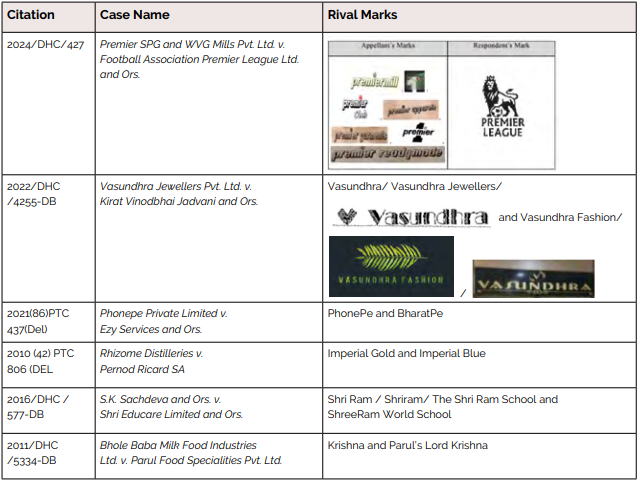
The views of the Courts have differed where the mark in question was either a commonly used word, had laudatory meaning, or the name of the deity. Some of the examples are listed in Table 1.
Table 1
To sum up
As businesses vie for consumer attention, the trend of copying elements of a senior mark or part of the mark that enjoys larger market share is likely to be resorted to by the new entrant to attract attention. Therefore, facts of each case will play a role in the determination of confusion and consequent infringement finding in the case of composite marks. Ultimately, it is consumer confusion that must be avoided.
This article was first published by the Trademark Lawyer Magzine.
