


Everest Food Products Pvt. Ltd. (The ‘Plaintiff’) a leading manufacturer and seller of spices and masalas under the brand name "Everest”, which has recognition since 1961 and over a period of time i.e. in 2002, expanded its portfolio by the introduction of a distinctive and coined term ‘Tikhalal’ exclusively towards chilli powders. The conflict here arose between Everest Food Products Pvt. Ltd. and Shyam Dhani Industries Pvt. Ltd (the ‘Defendant’), was significantly over the trademark “Tikhalal” which had acquired tremendous goodwill and reputation in the market by the Plaintiffs. At the core of this case lay not only the undeniable similarities between the marks but also issues such as the credibility of evidence, the doctrine of estoppel, and the pivotal role of fabricated invoices presented by the Defendant to bolster their claims of prior use.
The Background
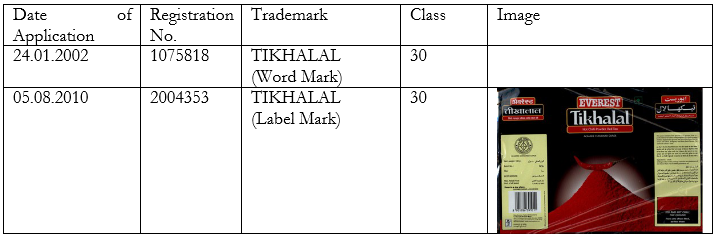
The Plaintiff along with its predecessor in interest were engaged in the business of inter alia manufacturing, producing, processing, exporting, importing buying, selling, distributing and dealing in all kinds and types of food products including all types of whole, pure and blended masalas, spices, herbs, seasonings and condiments for Indian dishes and international cuisines. In around 2000-2001, the Plaintiffs coined and invented an uncommon word ‘Tikhalal’ which does not have dictionary meaning in English or any other Indian languages. The Plaintiff also holds a registration over the trademark ‘Tikhalal’, with the relevant details outlined below:
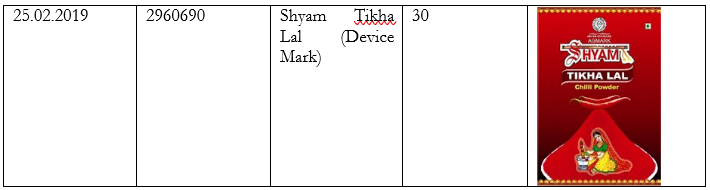
In 2019 Everest discovered that Shyam Dhani Industries Pvt. Ltd. marketed a similar product under the mark “SHYAM TIKHA LAL,” prompting a legal battle. The Defendants had registration of the mark ‘SHYAM TIKHA LAL’ details pertaining the same are given below:

Key events Actions Taken By Plaintiff:
- Plaintiff filed Rectification Application before the Registrar of Trademark against the registered application of the Defendants, which remains pending.
- On 20th September 2019, The Plaintiff issued a cease-and-desist notice, which was ignored by the Defendants.
- On 20th April 2021, the Plaintiff filed the present Suit and Interim Application against the Defendants before the Bombay High Court.
Evidence: The Foundation of Legal Success
A cornerstone of the case was the Plaintiff’s ability to present robust evidence, including:
- Sales turnover data from 2009-2010 to 2018-2019
- Promotional material, Sales invoices demonstrating the extensive use of “Tikhalal.”
- Advertisements in cinema halls, CD containing videos of Plaintiff’s commercial advertisements, e-commerce websites.
The Defendants on November, 30th, 2021, had filed a trade mark application for the word mark “SHYAM TIKHA LAL” under Application No. 5227639 in Class 29 with certain documents proving alleged use of the Impugned mark. Additionally, in the year 2019, the Defendants had applied for 8 other trade mark applications for unrelated trademarks containing inter alia the word “SHYAM”, wherein the Defendant has produced documents before the Trade Marks Registry to show its alleged use of the trademarks applied for by the Defendant. Further the Plaintiffs, upon scrutiny found out the documents produced in these 8 applications and the trademark application under application no. 5227639 contains alleged sales invoice dated 1st April 2006 bearing No. 1 addressed to one Kalika General Store, is identical with the alleged sales invoice produced at page 9 of the Defendants’ Affidavit in Reply, except for some glaring discrepancies in the description of the goods stated in these invoices. This dishonest conduct eroded their credibility and became a deciding factor in the judgment. (Kindly refer to Page No. 10 of this judgment copy for the alleged sale invoice).
As a practitioner, the lesson here is clear: integrity in presenting evidence is non-negotiable.
Key Legal Issues and Arguments
- Trademark Infringement:
- Plaintiff’s Claim: The Plaintiff contended that “Tikhalal” is arbitrary and invented, with no descriptive meaning, making it a strong trademark under the Trademarks Act, 1999. They even stated that the Defendants’ mark “SHYAM TIKHA LAL” is phonetically, visually, and conceptually similar to “Tikhalal.”. Further, the minor variation (adding a space) does not eliminate confusion. Evidence showed that “TIKHA LAL” was prominently displayed as a trademark on the defendant’s packaging, indicating its use as a brand identifier.
- Defendant’s Defence: The Defendants argued that the mark “TIKHA LAL” describes the spicy nature of chili powder and is not used as a trademark. Further, stating that “TIKHA LAL” was descriptive under Section 30(2)(a) of the Act, which permits descriptive use in good faith.
Court’s View: The Court concluded that “Tikhalal” and “TIKHA LAL” were deceptively similar. It rejected the descriptive use defence, emphasizing that “TIKHA LAL” was used not in any descriptive sense, but as a Trade Mark which is evident from the manner which the Defendants are using the Impugned mark ‘TIKHA LAL’ on their goods as well as the Defendant’s own Trademark applications for the Impugned Mark. This Court in Jagdish Gopal Kamath v. Lime & Chilli Hospitality Services (supra) has held that “it is the use of a mark otherwise then as a trade mark i.e., purely for descriptive purposes. Here, the Defendant is using the mark not in any descriptive sense, but as a trade mark. This is obvious from the Defendants’ own application for registration.”
- Fabricated Sale Invoices:
- Plaintiff’s Claim: The Plaintiff alleged that the Defendants submitted fabricated sales invoices and contradictory affidavits to falsely establish prior use of "TIKHA LAL," highlighting their bad faith.
Defendants Defence: The Defendant filed an affidavit dated 1st October 2024, wherein he had given a newfound explanation that due a misprint caused by error of computer software the Impugned mark “TIKHA LAL” is absent in the alleged sales invoice filed along with trade mark applications before the Trade Marks Registry.
Court’s View: The Defendants in my prima facie view have deliberately fabricated Sales Invoices including Sales Invoice dated 1st April, 2006 by adding the words “TIKHA LAL” and produced the same before this Court in an attempt to falsely show their use of the Impugned mark “TIKHA LAL” to mislead this Court. The Affidavits which have been filed by the Defendant viz. Affidavit dated 12th September, 2024 and 1st October, 2024 are contradictory to each other and no satisfactory explanation is forthcoming from the Defendants for the discrepancies therein and in the Invoices which have been produced. Further, the fabrication of evidence justified exemplary costs and reinforced the Plaintiff’s entitlement to relief. Thus, the Court relied upon the decision of the Supreme Court in Laxmikant V. Patel vs. Chetanbhai Shah (supra) and the Division Bench of this Court in Medley Laboratories (P) Ltd. vs. Alkem Laboratories Limited (supra) which have held that mere likelihood of confusion is sufficient and Plaintiff need not prove actual confusion.
- Passing Off:
- Plaintiff Claims: It is submitted that by using the Impugned mark ‘TIKHA LAL’ in respect of the Impugned Goods, the Defendants are passing off their impugned goods as those of the Plaintiff’s Trademark ‘Tikhalal’. Thus, The Defendants’ actions amount to passing off their goods as those of the Plaintiff, harming the Plaintiff’s goodwill.
- Defendants Defence: The Plaintiff failed to demonstrate any instance of actual consumer confusion. The Defendants’ asserted they had been using “SHYAM TIKHA LAL” since 2015 without any objections from the Plaintiff. The Defendants’ contended that the Plaintiff delayed in taking action against their use of the mark, implying acquiescence. During the proceedings, the defendants offered to modify their trade mark to “TIKHA TEJ” or “TIKHA TIKHA”, subject to the outcome of the suit.
Courts View: The Defendants’ trademark registration of “SHYAM TIKHA LAL” was inconsistent with their argument that “Tikha Lal” was descriptive. This contradiction invoked the doctrine of estoppel, barring them from claiming the descriptive use defence. The Court found that the Defendants action constituted passing off, as they misrepresented their goods as being associated with the Plaintiff’s established brand. The Court rejected the delay argument, noting that the Plaintiff acted promptly after discovering the Defendant’s use of the mark. The Court emphasised that protecting trademark rights benefits consumers by preventing confusion. The balance of convenience favoured the Plaintiff, and an injunction was necessary to prevent irreparable harm.
The Court issued an injunction restraining the Defendants from using “TIKHA LAL” or any deceptively similar mark. Relying on precedents like Midas Hygiene v. Sudhir Bhatia (2004), the Court granted an injunction, stating that dishonesty negates equitable defences like delay or acquiescence.
Courts Inputs:
- Defendants Trademark Registration: The Defendants trade mark registration is in my prima facie view ex-facie illegal, fraudulent and of a nature that would shock the conscience of the Court. Thus, the present case squarely fits within the small window left open by the Full Bench of this Court in Lupin Ltd. vs. Johnson and Johnson (supra). This Court in Riya Chemy (supra) applied the test laid down in Lupin Ltd. Vs. Johnson and Johnson (supra) and granted the relief of trade mark infringement against the Defendant therein who was a registered Proprietor of its trade mark by going behind the validity of its trade mark registration at the interim stage. The present case is one of such case where this Court is required to go behind the validity of the Defendants’ trade mark registration at the interim stage.
Conclusion The Everest vs. Shyam Dhani case exemplifies how meticulous documentation, ethical conduct, and robust legal strategies determine outcomes in trademark disputes. It is a clarion call for businesses to uphold integrity and for legal practitioners to leverage legal principles effectively. As the adage goes, “Prevention is better than cure” — and in trademark law, foresight and diligence are the best preventatives.
