


Introduction
The Administrative Court and the Court of Appeal have considered several cases which have raised procedural irregularities when transferring proceedings from a magistrates’ court to the Crown Court. For the Crown Court to have jurisdiction to deal with a case it ordinarily requires it to be properly transferred under the appropriate legislative provision. On 1st April 2024, the amended Criminal Procedure Rules come into force. For the first time, the rules contain procedural steps that are to be taken where it is necessary to correct errors in the court records that are identified upon transfer.
This is a topic which has caused difficulties. s51 Crime and Disorder Act 1998 (‘CDA 1998’) is a complex provision and requires careful consideration in the circumstances of each case to ensure that the court is: a) exercising its power appropriately, b) achieving the intended result, and c) recording that result accurately.
Key Legislative Provisions
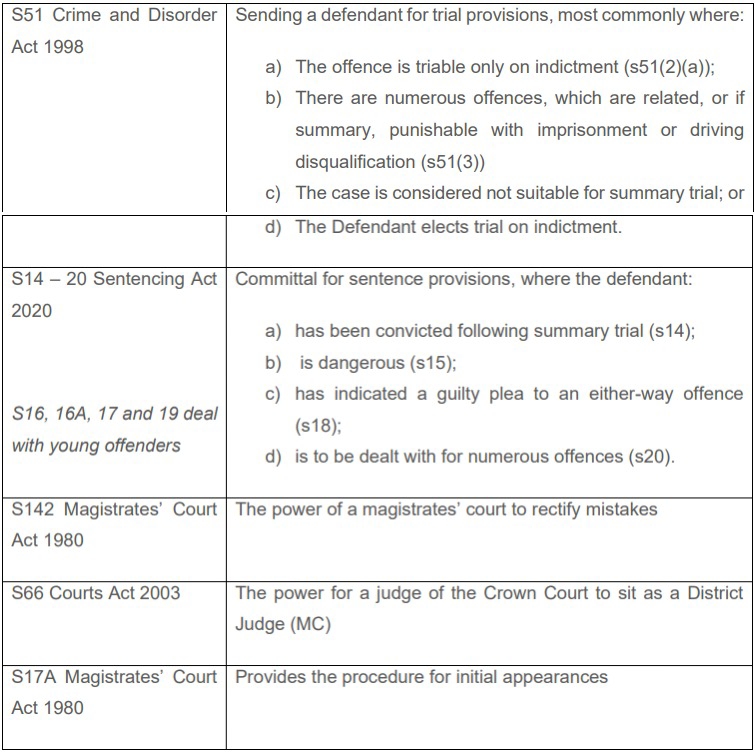
The provisions governing the transfer procedure are numerous. The key, and most frequently cited ones are summarised below:
Case Law Developments
The decision in R v Butt and Jenkins [2023] EWCA Crim 1131
This was a combined appeal. Butt and Jenkins raised different procedural issues, but were both concerned with the situation where an either-way offence can be accompanied by other such offences or summary offences. When faced with a potential error in the transfer of proceedings, a four-limb test is to be applied, as per Edis LJ [64]:
- What power was exercised by the magistrates’ court when sending or committing a case to the Crown Court?
- Was the power exercised erroneously?
- If so, what are the consequences of the procedural error?
- What steps can or should be taken to correct the error?
When determining the answer to (1), it is a question of fact as to what power was utilised. This can be discovered from the sending sheet, the Better Case Management Form, or the Court Extract (a document produced by the Common Platform system upon the administrative resulting of a case). The court must determine what power was actually exercised in the magistrates’ court, rather than the power that was purportedly recorded (per Judge LJ, R v Ayhan [2011] EWCA Crim 3184 [16]).
When considering (2), it is necessary to consider a) what the defendant indicated through the S17A procedure, and b) whether that is achieved through the exercise of the power in consideration. If a defendant indicates a guilty plea, but the court then proceeds to send the case to trial under s51 CDA 1998, that would be a clear procedural error and would be erroneous.
Steps (1) and (2) can be considered with not too much difficulty, provided that the Crown Court is in receipt of the relevant material as to what occurred in the magistrates’ court. As to (3), if the defendant is committed, when they should have been sent (or vice versa), the Crown Court has no jurisdiction to deal with the matter, save for if it operates its functions under s66 Courts Act 2003 (‘s66’). In respect of nullification, Edis LJ provides further examples of procedural errors (at [82]), for example where the s17A procedure has not been followed, it has the effect of invalidating any subsequent proceedings. This is unsurprising as S17A is fundamental, it must be followed in its entirety, as it protects the election rights of a defendant.
The final question (4) is perhaps the most significant. When faced with a defective Court Extract, the Crown Court has two options:
- It may hold that the defect is so fundamental that nothing has happened which gives jurisdiction to the Crown Court. If that is so, the case has not left the magistrates' court and the Crown Court judge may lawfully have recourse to s66 and deal with the case as a DJ(MC).
- It may apply Ayhan and other cases and deal with the case as validly committed if the magistrates' court had the power to commit and the Court Extract or sending sheet has failed to identify that power.
There are limits to sitting through s66, and before its utilisation, it is vitally important to consider the appropriateness of its use, as set out in R v Gould [2021] WLR(D) 190. In summary:
- Subsequent proceedings can be invalidated if the Crown Court makes an order which would be in excess of the magistrates’ court jurisdiction;
- The judges of the Crown Court are likely less familiar with the procedures that take place in the magistrates’ court, as to resulting and recording, especially considering the numerous requirements under the Magistrates’ Court Rules 1981;
- If the Crown Court judge is unsure whether to use the power, the safe option will usually be to refuse to do so; the prosecution must be able to assist the court if it is inviting it to exercise s66;
- If the power is used, reconstitution is not necessary, but clear explanation and reasoning must be given explaining exactly what powers are being utilised, and why.
If, on the other hand, the magistrates’ court makes an order which on its face transfers jurisdiction to the Crown Court, but that order is arguably not valid (for example, due to non- compliance with s17A), the Crown Court has no power to do anything. Exercising s142 under the s66 power does not apply, as the magistrates’ court no longer has jurisdiction over the case: it is functus officio. The Crown Court also has no power to quash an irregular order, for example, a purportedly bad committal, as demonstrated in R v Sheffield Crown Court & Anor (1994) 15 Cr App R (S) 768, where a Recorder’s decision to remit the case back to the magistrates’ court on the grounds that the committal was invalid was quashed. If there is any challenge to the legality of an order (which is distinct from a resulting error/an order bad on its face), then the Divisional Court is the only appropriate venue to adjudicate that issue.
The decision in R v Clark [2023] EWCA Crim 309, and considering it alongside R v Ayhan [2011] EWCA Crim 3184
The court in Clark (decided before Butt and Jenkins) considered the appropriate procedure where an error is presented on the face of a sending sheet. It concerned two offences: assault occasioning actual bodily harm and an offence of breaching a restraining order. The former was subject to a not-guilty plea, but the defendant entered a guilty plea for the latter. The Better Case Management Form showed that the defendant had entered guilty pleas, but the sending sheet showed that the matter was sent for trial under s51(1) and (2)(b) CDA 1998. It was held that:
[19] “It would have been an administrative error if the committal for sentence was made under the wrong statutory provision. It is that sort of case that the Crown Court need not be unduly concerned by and can proceed with by treating the error as an administrative one. In this case, by contrast, the sending by the Magistrates' Court was a sending for trial. That was obviously invalid because a guilty plea had been entered and there was therefore no jurisdiction in the Magistrates' Court to send the breach offence for trial. The only evidence of what the Magistrates did is the sending sheet itself and this does not support or confirm that the procedure set out in section 17A of the Magistrates' Court Act 1980 was followed. Counsel relied on the Better Case Management form but that does not assist us. That form would have reflected a guilty plea if Mr Clark had merely indicated a plea before venue on an either-way offence. As we have said, it is the sending sheet that is the primary record, and it is the sending sheet that matters.”
Thus, the court proceeded to show that the remedy would be for the Court of Appeal to sit as a Divisional Court, dispense with service of the claim form, extend the necessary time limits, grant permission to apply for judicial review, and quash the original committal. This was a lawful way of dealing with the issue, but consideration was given to this approach in Butt and Jenkins.
The court in Clark refers to Ayhan, and did not hold that it was wrongly decided. However, the Court of Appeal in Butt and Jenkins identified that it did not follow the established principle referred to above that it is the order which the magistrates’ court actually makes which gives the Crown Court jurisdiction, and not how it is recorded. The mis-recording on a sending sheet does not result in a committal being invalid. The Better Case Management Form is valuable evidence to assist in determining what occurred below. If issues cannot be resolved under s66, and the committal is bad on its face so that the case never actually left the magistrates’ court, then it will normally be for the prosecution to take the matter back to the magistrates’ court and correct the issue.
The decision in DPP v The Crown Court at Luton [2023] EWHC 2464 (Admin)
The Director of Public Prosecutions sought quashing orders in respect of the decisions of two Recorders who declined to deal with a defendant due to errors in the sending/committal procedure. Both defendants (Toner and Thompson) had been incorrectly sent for trial under s51(1) and 51(2)(b) CDA 1998 for offences which had already been subject to indications of guilty pleas.
Toner appeared in the magistrates’ court charged with five offences, all of which were either- way misuse of drugs offences. The Court Extract showed that he had indicated guilty pleas to three offences, but for the remaining two it read “Indicated Plea: Not Guilty or None”. Notwithstanding the guilty pleas, the defendant was sent, purportedly under s51 CDA 1998, to the Crown Court for trial on all offences.
The Better Case Management Form confirmed the defendant’s guilty pleas, recorded a not guilty plea for the supply of Class A drugs offence, and recorded the material issues. Enquiries were made to correct the Court Extract, however, this was not possible, so the court placed a note on the digital system to say that the case should have been resulted by way of committing the defendant under s14 Sentencing Act 2020. In light of this, under s142 Magistrates’ Court Act (‘s142’), District Judge Buttar set aside the original sending sheet, and thereby committed the offender for sentence under s14 Sentencing Act 2020.
The Recorder, relying on the decision in R v Clark [2023] EWCA Crim 309, held that there was no jurisdiction to sentence the offender for the three offences to which he had indicated guilty pleas, and held that the Divisional Court needed to quash the decision of the magistrates’ court to send the case under s51 CDA 1998.
The Court of Appeal held that Clark was not binding authority in these circumstances: there had been a clear resulting error, and provided that the Crown Court could be satisfied that the magistrates’ court made the correct order, despite what is shown on the Court Extract, then it had jurisdiction to deal with the case.
In the matter of Thompson, he appeared before the magistrates’ court charged with five offences: four either-way misuse of drugs matters, and a summary-only offence (possession of an offensive weapon). The Court Extract indicated that all matters were sent for trial pursuant to s51(1) and (2)(b) CDA 1998. However, the Better Case Management form recorded that guilty pleas had been indicated for the production of cannabis, and the possession of an offensive weapon.
Unlike Toner, there was no order under s142, nor was there a statement from the Legal Adviser that the Court Extract had been recorded in error. The offences to which guilty pleas were entered could have been properly committed for sentence (50A(3)(b)(ii) CDA 1998). Therefore, the options open to the Crown Court were:
1) To hold that the record of what had happened in the magistrates' court was bad on its face and that nothing had occurred there which could confer jurisdiction on the Crown Court to deal with these two charges. They therefore remained in the magistrates' court which was not functus officio. The Crown Court judge may decide to sit as a DJ(MC) under s66 and, if so, may also decide to exercise the powers of the magistrates' court under s142.
or
2) To hold that it is sufficiently clear from all the evidence that the either way offence was committed for sentence under section 14 of the Sentencing Act 2020, and the summary-only offence was committed for sentence under section 20 of the Sentencing Act 2020, and to proceed to sentence on this basis.
The Recorder’s decision that the Crown Court did not have jurisdiction to sentence was quashed. On the point of remedy in the Divisional Court, it is important to consider the effect of section 31(5A) of the Senior Courts Act 1981. If the court quashes, for example the decision of the Crown Court judge, it is then unable to then substitute its own decision if more than one decision could be made. The appropriate action would be to remit the matter to the Crown Court judge to decide which decision to make.
Criminal Procedure Rules
On 1st April 2024, the amended Criminal Procedure Rules come into force. The rule committee has recognised this as an area which requires guidance. It is no doubt a welcome addition to provide structure to the process where a potential transfer error has occurred. The relevant rule is at r5.4. It provides:
“Where a court (“the receiving court”), or a party to the proceedings before that court, questions the accuracy of a record of a decision by a court (“the transferring court”) which sent a case for trial, committed, remitted or transferred a case for sentence or other determination, or from which an appeal has been brought to the receiving court:
- the court officer for the transferring court must review that record;
- if that record appears to be correct then the court officer for the transferring court must so inform the receiving court as soon as practicable, explaining that conclusion; and
- if that record appears to be incorrect then the court officer must correct it.”
Conclusion
In summary, the following principles can be drawn from the above:
- When a case is being transferred, the appropriate legislative provision must be identified and accurately recorded. If a potential error is identified, the procedure set out in r5.4 of the amended CrimPR once in force must be followed.
- It is important to consider what order the magistrates’ court actually made, by considering material such as the Better Case Management Form, the Court Extract, the sending sheet, and the powers available to the magistrates’ court when considering the particular offence.
- If the order displayed on the Court Extract is plainly bad on its face, then the Crown Court judge may, upon consideration of the principles in Gould, exercise its power under s66, and use s142 to remedy the issue. If s66 is not used, the prosecution is to take the case back to the magistrates’ court to be sorted out (the Crown Court is unable to remit the case or make any orders as the offence has technically not left the magistrates’ court).
- If the Crown Court comes to the conclusion that the sending/committal has been mis- recorded, but is satisfied that the case has been sent/committed appropriately, it may proceed to deal with the defendant, applying the principles in Ayhan, and other cases.
- If the order is one that on its face validly transfers jurisdiction to the Crown Court, but there is a dispute as to its legality/validity, it has no power to remit the case, exercise s66, or make any quashing orders. If the order is irregular, the Divisional Court will be the appropriate venue to consider that issue.
Following the clear guidance given by the Court of Appeal in Butt and Jenkins, and the introduction of a procedure for correcting court records in these circumstances, it may be seen that fewer uncertainties arise when procedural errors are identified.
