

New year, new rules. From anti-money laundering to political donations, 1 January 2026 brings a wave of financial crime compliance changes across multiple jurisdictions.
These shifting rules raise the stakes for businesses and executives, with tougher liability, stricter transparency, and significant penalties for non-compliance.
Lexology PRO highlights five key financial crime deadlines for your calendar.
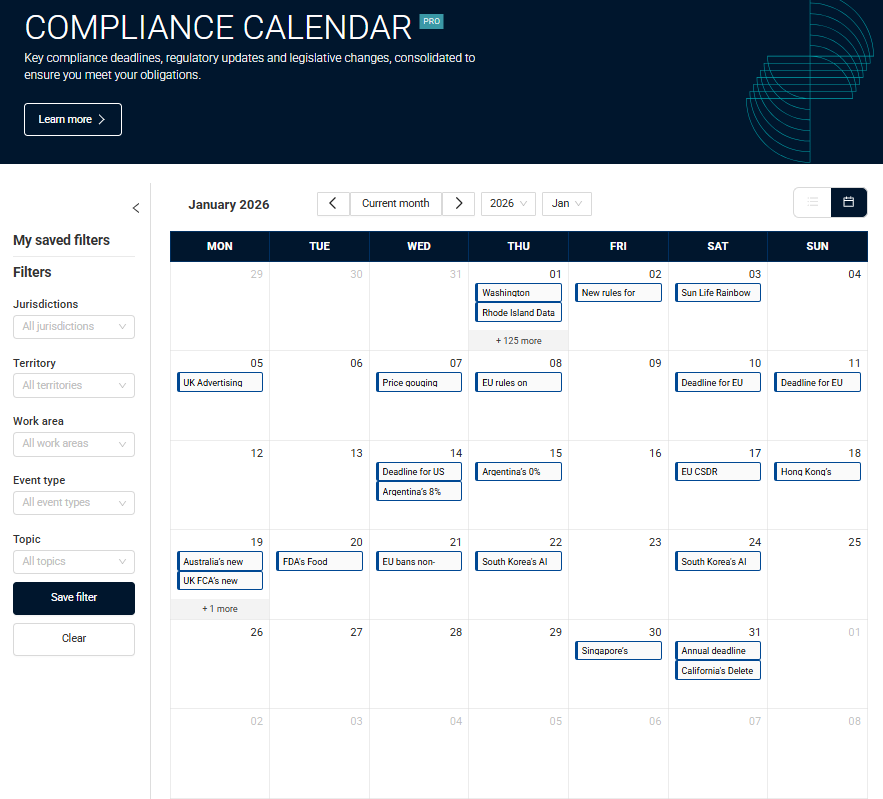
See our new interactive Compliance Calendar for key deadlines and dates in core compliance areas throughout, including enforcement dates, reporting deadlines and changes to regulations.
Hungary expands corporate liability with new criminal code
Starting on 1 January 2026, Hungary’s revised Corporate Criminal Code means companies can be held criminally liable for negligence, including corruption, even without intentional involvement by executives.
Companies will be liable if they benefit from a criminal offence or if company resources were used in a crime, regardless of intent. Executives may also be held accountable if they fail to prevent misconduct.
Fines may reach up to 5% of annual turnover, and foreign or successor companies may also be liable.
Lithuania strengthens AML rules for payment institutions
Electronic money and payment institutions in Lithuania must comply with stricter AML rules from 1 January 2026, following regulatory amendments issued by the country’s Central Bank (Lithuanian language only).
Under the revised framework, institutions must enhance their internal AML controls, including protocols for transaction monitoring and ongoing risk assessments.
Further provisions will apply from 1 January 2027 (Lithuanian language only).
The changes are part of a broader effort to strengthen financial sector integrity and align Lithuania with evolving EU AML standards.
US investment advisers may face stricter AML/CTF rules
From 1 January 2026, some investment advisers in the US could face stricter AML/CTF requirements under the Bank Secrecy Act 1970, following new regulations issued by the Financial Crimes Enforcement Network (FinCEN) in September 2024.
Under the revised rule, advisers will be classified as “financial institutions” and must implement a risk-based AML/CTF programme. They will also be required to report suspicious activity to FinCEN within 30 days of detection. The proposed rules aim to close regulatory gaps in the investment advisor sector, which has previously been used to channel illicit funds.
Whether the changes come to pass remains uncertain, however. On 22 September 2025, FinCEN signalled its intent to postpone the implementation date of the new rule by two years, to 1 January 2028.
Japan tightens political donations rules
Stricter regulations around political donations will take effect in Japan from 1 January 2026, aiming to boost transparency and accountability.
The revised rules mean businesses must pay for tickets to political fundraisers exclusively via bank transfer, with cash payments largely prohibited. This shift seeks to reduce the risk of opaque or undocumented transactions.
Companies are also required to retain detailed records of all bank transfers related to political donations. These must be made available on request by authorities, such as the Ministry of Internal Affairs and Communications or the Election Administration Commission, to ensure compliance with disclosure obligations.
BVI extends deadline for beneficial ownership filings
1 January 2026 marks the deadline for companies in the British Virgin Islands (BVI) to submit beneficial ownership information under amendments to the Business Companies Act 2004. Originally set for 1 July 2025, the deadline was pushed to 1 January 2026.
From that date, companies are required to file beneficial ownership information with the BVI Registrar of Corporate Affairs. This includes submitting a register of members and, where applicable, details of beneficial owners and any relevant changes.
The new rules apply to all existing BVI companies, not just new incorporations. Companies should review their structures to ensure all beneficial ownership data is accurate and up to date.