

This checklist was produced as part of a joint know-how initiative between Eversheds Sutherland and Lexology Pro.
Introduction
This checklist provides in-house counsel, private practice lawyers and human resource professionals with a methodology for dealing with multi-jurisdictional redundancies. It is particularly useful for those advising or working for multi-national organisations.
The guide includes specific legal scenarios in the UK, Italy, Germany, France and the Netherlands.
This checklist addresses the following steps:
- Gather key information and draw up a project plan
- Understand the legal position in each jurisdiction
- Establish the likely costs for each jurisdiction involved and calculate a budget
- Review and update the project plan
- Consider difficult issues and manage key risks in each jurisdiction
This guide can be read in conjunction with How-to guide: How to work with works councils in Germany and Quick views: Co-determination by German works councils and Key players in collective labour law - UK, Germany, Italy, France and the Netherlands.
Step 1 – Gather key information and draw up a project plan
| No. | Requirement |
| 1.1 | Identify the affected locations, employees and employers |
| 1.2 | Establish whether there are employee representatives at the affected locations |
| 1.3 | Establish the business case for the redundancies |
| 1.4 | Consider the key provisions of the relevant employment contracts and/or collective bargaining agreements in each location |
Step 2 – Understand the legal position in each jurisdiction
| No. | Requirement |
| 2.1 | Identify whether a potentially fair reason for dismissal is required and what constitutes a fair reason |
| 2.2 | Understand a basic outline of the dismissal process |
Step 3 – Establish the likely costs for each jurisdiction and calculate a budget
| No. | Requirement |
| 3.1 | Understand the required statutory payments |
| 3.2 | Identify any other likely costs |
| 3.3 | Balance costs vs hoped-for costs savings |
Step 4 – Review and update the project plan
| No. | Requirement |
| 4.1 | Revisit plans following receipt of legal advice |
| 4.2 | Establish project team and timescales |
Step 5 – Consider difficult issues and manage key risks in each jurisdiction
| No. | Requirement |
| 5.1 | Consider the impact of any employees with special protections |
| 5.2 | Ensure the selection criteria in each jurisdiction is lawful |
| 5.3 | Understand the main risks in each jurisdiction |
| 5.4 | Consider the use of mutual termination agreements |
Explanatory notes
Legal framework
Carrying out a multi-jurisdictional redundancy exercise in Europe is challenging due to the variety of employment legislation across Europe. In certain areas – for example, collective redundancies and transfers of undertakings, relevant EU-level directives exist, but the implementation of these directives in the different European countries varies considerably.
In other areas of employment law, there has, so far, been no EU legislative activity, meaning that there is no set of basic minimum standards across the EU. This is the case, for example, in relation to rules on changing terms and conditions of employment. These rules will therefore be governed by national contract law and statutory rules.
Particular areas of difficulty include those listed below:
- The timelines for required consultation will vary in different countries.
- The time, cost and difficulty involved in making redundancies vary from country to country.
- Employees from different jurisdictions may talk to each other and compare what is happening and what terms are being offered to redundant employees.
- The management team who are driving the decisions are likely to be familiar with the complexities in only one jurisdiction, if any.
Where decisions are driven by a parent company, particularly one based in a different jurisdiction, it will be essential at an early stage to identify trustworthy local management to take on board as part of the planning and implementation team. Unless an organisation has very good in-house legal and HR teams in each country, external legal advice for each jurisdiction will be essential.
Step 1 – Gather the key information and draw up a project plan
The best way for organisations to cope with the challenges posed by a multi-jurisdictional redundancy exercise is with careful and thorough planning. Without having prepared a detailed project plan with fallback options, there is a risk that the process in each jurisdiction becomes more time-consuming and costly than anticipated.
In the early stages of the process employers may not be able to obtain all the information required, but it is important to at least identify the information that is needed and gather as much as possible at the outset.
1.1 Identify the affected locations, employees and employers
At the outset of the process employers should:
- identify the countries impacted and the exact workplace or site locations that are affected within each country;
- establish how many employees are employed at each affected location and how many dismissals are proposed in each location;
- identify the legal entity that is the employer in each of the affected locations; and
- prepare organisation charts of the workforce now versus the planned future state.
1.2 Establish whether there are employee representatives at the affected locations
The presence of works councils and/or trade unions can greatly impact upon the timeframe, costs and complexity of a redundancy exercise in many European jurisdictions.
For general information about trade unions and works councils see Quick view: Key players in collective labour law - UK, Germany, Italy, France and the Netherlands.
1.3 Establish the business case for the redundancies
Establishing the business case for redundancies (eg. a site closure or a reduction in work) is an important step that should be considered at the outset of the process; in particular, because it may be relevant to the lawfulness of any dismissals that follow. This is outlined in more detail at 2.1 below.
1.4 Consider the key provisions of the relevant employment contracts and/or collective bargaining agreements in each location
Provisions that may be particularly relevant to a redundancy exercise include those relating to:
- notice periods;
- garden leave and/or payment in lieu of notice clauses; and
- severance payments.
Step 2 – Understand the legal position in each jurisdiction
It is a good idea to take the information gathered at step 1 and use it to obtain specific legal advice in relation to each jurisdiction. Legal requirements will vary significantly across different jurisdictions.
The key legal questions to consider in each country are set out below.
2.1 Identify whether a potentially fair reason for dismissal is required and what constitutes a fair reason
In many jurisdictions an employer will need to establish a ‘fair reason’ for any dismissal in order for the dismissal to be lawful and to avoid employee claims. In the case of dismissals due to redundancy, this may mean the employer has to demonstrate that it has an economic basis for making redundancies. Employers will also need to consider the extent to which employees can claim unfair dismissal, and the potential costs and other implications of this.
Some examples include:
| UK |
|
| Germany |
|
| Netherlands |
|
| France |
|
| Italy |
|
Once the requirements in relation to a ‘fair reason’ for dismissal have been established in each country, these will need to be cross-referenced against the employer’s business case referred to at 1.3 above, in order to ensure that the legal requirements are met.
2.2 Understand a basic outline of the dismissal process
The process employers must follow before effecting redundancies will vary significantly across different European jurisdictions. Other factors that may impact the required process include the number of proposed redundancies and whether or not the employees are represented by a trade union or works council. The key steps for most redundancy processes in Europe are set out below.
2.2.1 Information and consultation process
Information and consultation is likely to be required in all jurisdictions prior to effecting redundancies, but the counterparts for the consultation vary. For example:
- Consultation with works councils (where present) is required in some countries, including Germany, France, the Netherlands and in some cases Italy.
- Consultation with trade unions (where recognised) may be required, including in the UK, Italy, the Netherlands and France.
- In certain countries consultation with other employee representatives is required, including in the UK (if there is no trade union) and the Netherlands (if there is no works council).
The degree of consultation required also varies, with consultation alone (ie, exchange of views) required in some countries (eg, the UK), and negotiation to reach agreement required in others (eg, Germany, the Netherlands and Italy).
Employers should note that in certain countries matters such as the timing of notifying works councils about potential redundancies and the consultation carried out can be crucial, with failure to comply having a significant impact on the process (see 5.3 below).
2.2.2 Involvement of state authorities
There is a varying degree of involvement of state authorities in redundancy processes, ranging from a requirement to notify certain authorities (eg, in the UK and Germany) to active involvement in the process (eg, in France, the Netherlands and Italy).
2.2.3 Timelines
From the outset, employers should be aware of the likely timeline for any redundancy process. The predictability of timescales varies considerably, with legally prescribed timescales in some countries (eg, the UK, Italy and France) and none in others (eg, Germany and the Netherlands).
Approximate timescales for a collective consultation process alone (ie, not taking into account additional requirements before and after, such as preparation, individual consultation and concluding termination agreements with employees) are:
- UK – 30 or 45 days (depending on the number of redundancies);
- Italy – 75 days to 8½ months;
- Germany – 4 weeks to 6 months;
- France – 2 to 4 months; and
- Netherlands – 2 to 6 months.
Example – collective redundancy process in the UK
Collective redundancy consultation is required if more than 20 dismissals are proposed at one establishment within 90 calendar days. This involves:
- identifying appropriate employee representatives ─ either from a trade union, existing employee forum or similar, or elected for the consultation process;
- issuing a section 188 letter to employee representatives, setting out information required by statute including the number of potential redundancies, the reasons for the potential redundancies and how employees will be selected for redundancy (see section 188 of the Trade Union and Labour Relations (Consolidation) Act 1992);
- filing Form HR1 to notify the government of potential redundancies;
- consulting with employee representatives for a minimum of 45 days (100+ redundancies) or 30 days (20 – 99 redundancies). The number, format and content of consultation meetings will depend on the proposals;
- holding individual redundancy consultation meetings in every case on a one-to-one basis with each affected employee – at least two individual consultation meetings will usually be required; and
- allowing a right of appeal against any redundancy decision.
Step 3 – Establish the likely costs for each jurisdiction and calculate a budget
Employers will need to calculate the likely cost of a redundancy project, taking into account the categories set out below.
3.1 Understand the required statutory payments
Compensatory payments are required in many European jurisdictions to be paid to employees who are made redundant. Such payments are referred to by various names including redundancy payments, compensation payments, transitional compensation or severance payments. In some cases (eg, in the UK), such payments are calculated based on a statutory formula, and in other cases they are determined by agreements with an employee representative body (eg, in Germany). Employers should also note that in many cases a statutory formula might be the baseline requirement, with employers also commonly agreeing enhanced payments with a trade union, works council or other employee representatives.
3.2 Identify other likely costs
Employees who are made redundant will likely also be entitled to notice pay, either by working their notice period, being placed on garden leave, or receiving a payment in lieu of notice. Employers should establish whether any provisions in contracts of employment or collective bargaining agreements impact upon how notice can or must be dealt with.
Other costs that employers may need to take into account include:
- statutory payments to state authorities – for example, in Italy industrial companies are required to make a ‘contributo di licenziamento’ (dismissal payment) for each employee to the National Institute for social security contributions;
- other payments owed to employees, such as payment in lieu of accrued and untaken holiday pay;
- the cost of legal advice; and
- the cost of management, HR and in-house legal counsel’s time that will be incurred during the redundancy process.
Example – redundancy costs in the Netherlands
- Notice pay ─ unilateral payments in lieu of notice are not permitted, and it is more typical for employees to either work their notice or be placed on garden leave. Statutory notice periods are between one and four months and are based on length of service. Contractual notice periods can be longer, but employer notice must then be at least double employee notice.
- Transitional compensation – payable to all employees as from the first day of employment and calculated at a third of the monthly salary per year of service, accrued on a daily basis (pro rata). ‘Salary’ comprises base salary + 8% holiday allowance + 13th month payment + average bonus + fixed emoluments. The payment is capped at the higher of €98,000 (2025) or one gross annual salary.
- Additional compensation ─ ordered by the court if the employer’s conduct has been seriously culpable (not capped).
- Pay in lieu of accrued untaken holiday.
3.3 Balance costs vs hoped-for costs savings
Once a rough costs budget for redundancies has been established, employers should balance this against the costs savings that the organisation is seeking to achieve through making the redundancies. As the cost of redundancies can be significant in certain jurisdictions, it is worth ensuring that the costs savings outweigh the budget before the redundancy exercise commences.
Step 4 – Review and update the project plan
Employers should review their project plan at each stage of the planning process and adjust as necessary on receipt of legal advice and as further information is obtained.
4.1 Revisit plans following receipt of legal advice
Following receipt of legal advice, employers should consider whether to adjust their initial plan due to the legal issues raised in each country. In particular, employers may need to consider whether their reasons for dismissal are sufficient to satisfy the requirements of local law (as outlined at 2.1 above). If not, employers may need to seek employee exits by agreement instead of (or in some cases as well as) carrying out a redundancy process. See 5.4 below for further information.
4.2 Establish project team and timescales
When finalising the project plan employers will need to take into account the factors listed below:
- How can the employer’s expectations in respect of timings be managed? For example, timings may be driven by management HQ in another jurisdiction with less detailed employment requirements. It will be crucial to flag the requirements to the decision makers in each country.
- Who will be tasked with implementation of the redundancy processes locally? Employers should ensure there is sufficient HR presence in each location to manage the process.
- How will the employer ensure communications are consistent across different countries that have different requirements and timelines for a redundancy process?
- How will employee communications be vetted? Employers should consider a centralised process that takes into account the requirements relating to works council notifications in different countries.
Step 5 – Consider difficult issues and manage key risks in each jurisdiction
There are a number of issues that can cause particular difficulties for employers when carrying out a redundancy exercise in Europe. Some of these are outlined below, together with options that may be available to employers to manage the risks.
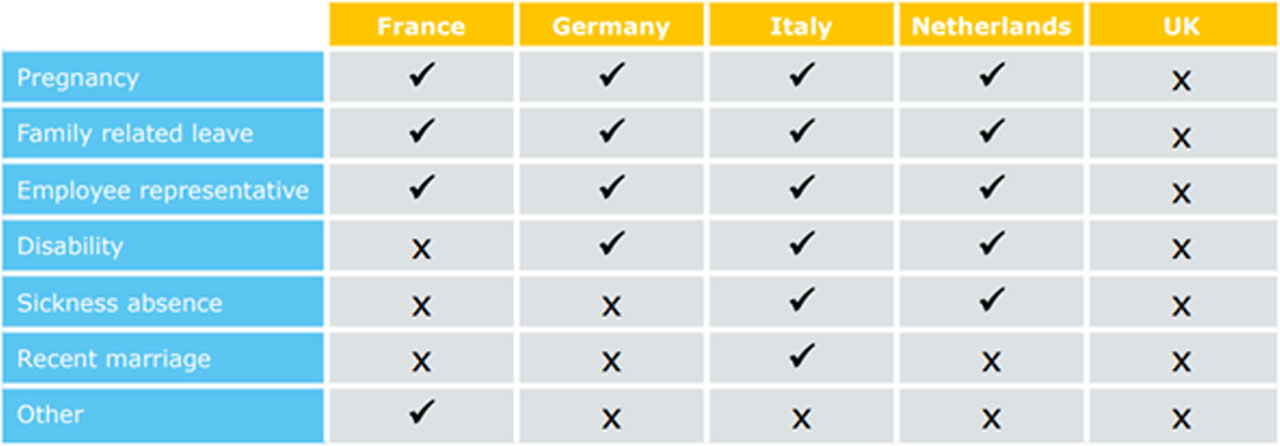
5.1 Consider the impact of any employees with special protections
Employers may face significant difficulties when seeking to make redundant certain categories of employees, due to special protections afforded to them by law. The meaning of special protection will differ for different jurisdictions and different categories, but could mean that before a redundancy can be effected:
- a special procedure must be followed; or
- permission is required from a public authority, which in practice might be difficult to obtain and, in some cases, may only be granted in the event of a full site closure.
The table below sets out the categories that trigger the requirement for some form of special procedure or permission in the UK, France, Italy, Germany and the Netherlands.
5.2 Ensure the selection criteria in each jurisdiction is lawful
If the employer’s operations are not closing completely in the jurisdiction in question it will be necessary to select which employees will be made redundant. Different rules apply for how to select employees in different jurisdictions, and different approaches will therefore be required for each location. For example:
| UK | Employer can determine the selection criteria subject to the need to avoid discriminatory criteria. |
| France, Germany and Italy | Selection criteria are prescribed by law, taking into account varying factors including age, length of service and family maintenance obligations. |
| Netherlands | The principle of proportionality applies to redundancy selection, requiring employers to divide employees into categories of interchangeable positions, and within those categories divide employees into age groups, and within age groups apply a last-in, first-out selection. |
Collective bargaining agreements may also include provisions relating to selection criteria.
5.3 Understand the main risks in each jurisdiction
Risk levels vary significantly during a redundancy process. The table below sets out the possible consequences for employers of failing to follow the correct procedure prior to making redundancies.
| UK | Implications are financial, with protective awards payable to employees for failures by the employer to inform and consult (currently at a maximum of 90 days/13 weeks’ pay and set to double as a result of the Employment Rights Bill), as well as potential unfair dismissal and discrimination claims. |
| Germany | In some regions there is a risk of injunctions, but usually the risk is financial, with 12 – 18 months’ compensation + damages for up to one year payable to employees. There is also a possibility of dismissals being void and employers being required to reinstate employees. |
| Netherlands | Failure to comply with the selection process requirements means that dismissals cannot proceed (ie, the UWV will not grant permission). Employers may also face injunctions to stop the redundancy process and can be ordered to pay financial compensation and reinstate employees. Criminal liability is possible if a court decision on employee consultation rights is not complied with. |
| France | Employers can face criminal liability for failing to consult a works council, resulting in fines for the employer and its representatives. Employers can also face injunctions to stop the redundancy process and can be required to pay unfair dismissal awards to employees. |
| Italy | Employers can face injunctions for anti-union behaviour and dismissals may be declared void and employees reinstated (only for workers hired before 7 March 2015). |
5.4 Consider the use of mutual termination agreements
Termination agreements, also known as settlement agreements, are commonly used in many jurisdictions to terminate employment. They allow employers to effect a mutual termination of employment with an employee, while also requiring the employee to waive their right to bring employment-related claims. Termination agreements can provide employers with certainty in relation to the timeline and costs of a redundancy project; however, additional compensation payments on top of statutory entitlements are usually required in order to incentivise employees to sign.
While termination agreements are common, the timing and form of the agreement will vary. In some cases (eg, in France) employers are required, or best advised, to introduce termination agreements towards the end of the process, in order to manage the risk of claims following the redundancies. In other cases, it is common practice to offer termination agreements at an early stage – for example, in the Netherlands where employment can only be terminated by agreement or with UWV approval.
Legal advice for the employee may be necessary in order for a termination agreement to be valid (eg, in the UK), or specific execution before the competent authorities may be required (eg, in Italy).
Termination agreements are therefore useful for employers to have in their tool box during a redundancy process, but will need to be tailored for each country.
Additional resources
Related Lexology Pro content
How-to guides:
How to work with works councils in Germany
How to carry out a fair termination of employment (UK)
Overview of employment law (UK)
Conducting a redundancy exercise (UK)
How to carry out a fair dismissal on the grounds of SOSR (UK)
How to work with works councils in the Netherlands
Checklists:
Employment, immigration and tax considerations when dealing with cross-border working
Carrying out workplace investigations in a cross-border context
Quick views:
Co-determination by German works councils
Key players in collective labour law - UK, Germany, Italy, France and the Netherlands
Collective redundancy consultation (UK)
Reliance on information posted:
While we use reasonable endeavours to provide up to date and relevant materials, the materials posted on our site are not intended to amount to advice on which reliance should be placed. They may not reflect recent changes in the law and are not intended to constitute a definitive or complete statement of the law. You may use them to stay up to date with legal developments but you should not use them for transactions or legal advice and you should carry out your own research. We therefore disclaim all liability and responsibility arising from any reliance placed on such materials by any visitor to our site, or by anyone who may be informed of any of its contents.